

The world has recently emerged from a profound global trial. We witnessed firsthand the devastating consequences of allowing untested biological platforms to be deployed at an unprecedented scale while demands for empirical safety data were met with coordinated silence. Humanity was asked to build its house on shifting sands, placing blind faith in corporate narratives rather than rigorous, independent science. When regulatory frameworks rely on proprietary press releases rather than transparent replication, public safety is compromised. Today, this exact battle over data integrity has migrated from laboratory biosecurity to the global food supply.
For decades, a powerful corporate narrative has sought to discredit traditional agriculture, framing the natural ecosystems that have sustained generations as inefficient relics. In their place, mega-corporations and venture-capital networks are aggressively positioning precision fermentation and synthetic biology (synbio) as the inevitable, ethical future of human nutrition. We must pause and ask a profoundly difficult question: Is dismantling the natural order in favor of patented, lab-derived fluids truly safe for our physical health, or are we being sold a corporate dependency model under the guise of progress?
As an independent virologist and molecular auditor, I must insist on looking past the marketing decks to examine the raw data. When we disrupt the natural order to replace whole foods with patented, laboratory-derived fluids, we are no longer innovating—we are conducting an uncontrolled, large-scale immunological experiment on the human population.
The Purity Illusion: Fungal Secretome Disguised as Dairy
To evaluate the validity of these novel products, we must strip away the marketing and analyze them at the molecular level. The synthetic dairy industry relies heavily on a single metric to convince the public of its safety: “B-LG content.”
B-LG stands for beta-lactoglobulin, the primary whey protein naturally synthesized in bovine milk. In a healthy, grazing cow, this protein does not exist in a vacuum. It is intricately bound within a magnificent biological matrix of lipids, vitamins, and essential cellular components. This natural design functions as a firm foundation for nourishment, perfected long before the advent of industrial laboratories.
In the realm of synthetic biology, biotechnology companies utilize precision fermentation to mimic this natural blueprint. They genetically engineer fungi—specifically Trichoderma reesei—programming it to excrete a recombinant, lab-created version of this bovine protein inside massive industrial bioreactors. The “B-LG content” of a synthetic dairy product is simply the measured percentage of this specific, lab-made whey protein present in the final fluid.
Recently, a landmark peer-reviewed study published in Scientific Reports completely dismantled the illusions surrounding this metric. The comprehensive analysis, titled "Multi-omics profiling finds synbio milk differs nutritionally from bovine milk and contains 93 uncharacterized fungal metabolites and 236 fungal proteins," provides the exact empirical data that corporate marketing teams attempt to suppress.

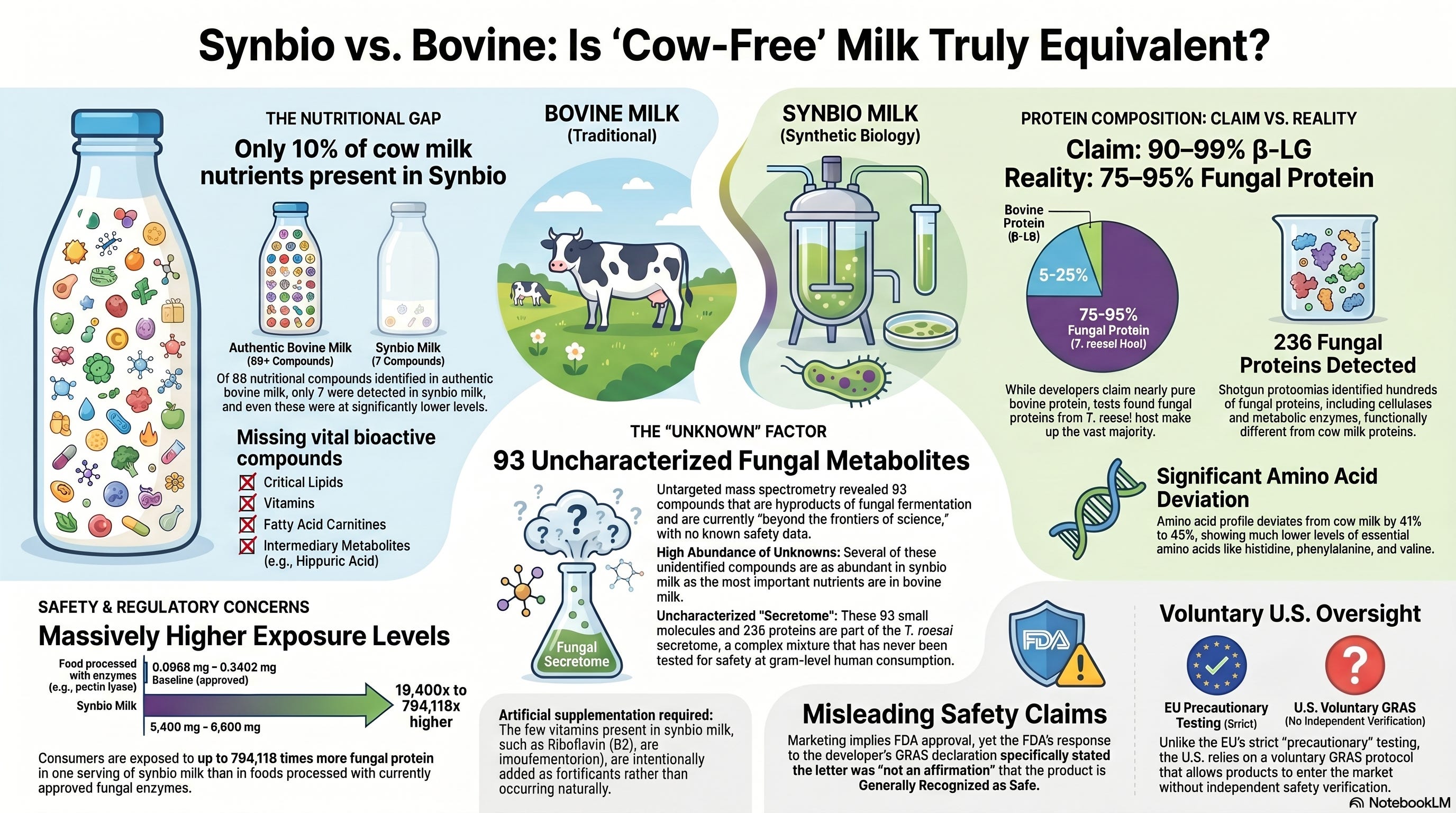
Product developers boldly claim that their synbio milk is a “bio-identical” match containing 90% to 99% pure recombinant B-LG. By utilizing untargeted mass spectrometry, ELISA, and shotgun proteomics, independent researchers looked past the corporate pitch decks and discovered a completely different reality. The data reveals that synbio milk is overwhelmingly composed of industrial fungal protein:
The Purity Deficit: The actual dairy-match B-LG content does not hit the promised 99%. It sits between a mere 7.0% and 31.8%.
The Fungal Overload: The remainder of the protein content—upwards of 68.2% to 95.0%—is entirely derived from the Trichoderma reesei fungus.
The Nutritional Void: Authentic bovine milk contains at least 69 essential low-molecular-weight nutrients, including vital lipids, vitamins, and fatty acid carnitines. Synbio milk is virtually devoid of these components, possessing trace amounts of roughly seven.
The Structural Divergence: The amino acid profile of the synthetic product diverges by approximately 40% from authentic milk, meaning it fundamentally lacks the essential structural building blocks human bodies naturally require.
Consumers are not being sold a clean, advanced alternative to traditional milk. They are being sold a fungal secretome disguised as a dairy equivalent.
Hidden Dangers and Real-World Immunological Consequences
The nutritional void is only the first layer of this deception. The true danger lies in the biochemical dark matter generated by precision fermentation.
Untargeted mass spectrometry analysis identified 93 distinct small-molecule compounds in synbio milk that remain entirely uncharacterized by modern science. These are biological waste products and unintended byproducts of fungal fermentation. Their chemical identities cannot be found in even the most massive mass spectral databases. We are faced with a commercial food product containing 236 distinct foreign fungal proteins and 93 unidentified fungal metabolites that have never been tested for human safety, chronic toxicity, or allergenicity at these extreme exposure levels.
In the real world, substituting a naturally complex, historically safe whole food with a highly processed fungal secretome poses severe health risks. For years, individuals with lactose intolerance or sensitivities to traditional dairy have sought safe alternatives. The biotechnology industry has eagerly targeted this vulnerable demographic, marketing synbio milk as a pristine, lactose-free solution.
This marketing is deeply deceptive. Families seeking refuge from a natural sugar sensitivity are unknowingly trading a known, manageable digestive intolerance for direct exposure to an unmapped biological soup. Furthermore, while synbio milk may omit lactose, it intentionally includes recombinant B-lactoglobulin (B-LG), which is one of the primary allergens found in traditional cow's milk. Individuals with true dairy allergies remain at acute risk, while everyday consumers simply looking for a clean alternative are subjected to an unprecedented barrage of industrial fungal waste.
The human body is a beautifully designed temple. It is intricately optimized to recognize, process, and thrive on whole-food matrices—it is fundamentally unequipped to handle industrial fermentation waste as daily sustenance. Recent peer-reviewed immunological studies on allergenicity of alternative proteins emphasize that novel proteins derived from fungi frequently share structural similarities with known environmental allergens.
When these unmapped foreign antigens flood the gastrointestinal tract, they bypass our natural immunological memory. This risks triggering severe IgE-mediated immune cascades, cross-reactivity, and unpredictable autoimmune sensitization. We simply do not know what chronic exposure to these 93 unknown molecules will do to human cellular pathways and gut health over the long term.
Regulatory Failure, the GRAS Loophole, and Legal Battles
How does a product containing over 90 unknown compounds bypass standard consumer safety testing and reach the grocery store? The answer lies in the exploitation of a regulatory loophole known as the United States FDA’s “Generally Recognized as Safe” (GRAS) protocol.
Mega-corporations routinely use this self-certification loophole to bypass rigorous pre-market safety assessments. Manufacturers of synbio milk point to older, legacy GRAS notifications for T. reesei enzymes used in traditional food processing to claim their new products are safe. In doing so, they deliberately obscure a catastrophic distinction in human dosing:
Micrograms vs. Grams: In traditional food processing, these fungal enzymes are used as minor processing aids, left behind only in microscopic, trace microgram quantities in the final food.
The Multiplier Effect: In synthetic milk, the fungal protein is no longer a trace processing aid—it is the primary structural ingredient, consumed in massive, multi-gram quantities.
This systemic regulatory failure exposes the consumer to foreign fungal proteins at levels 19,400 to 794,118 times higher than foods processed with standard recombinant enzymes were ever intended to deliver.
This is not innovation; it is institutional negligence, and it has already triggered fierce legal battles. Recent consumer protection litigation targeting companies producing animal-free dairy highlights these deceptive marketing practices Plaintiffs argue that these conglomerates violate the law by marketing products as safe, sustainable, and identical to cow’s milk, while actively obscuring the massive presence of residual host-cell fungal material.
Furthermore, during recent public meetings, experts testified that synbio products have even revealed traces of fungicide residue alongside their 93 uncharacterized small molecules. Regulatory agencies are once again choosing to rely on biased industry assurances rather than demanding independent, empirical auditing.
The War on Traditional Agriculture and Corporate Monopolies
To implement a synthetic future, the natural past must be systematically dismantled. Over the past few years, we have witnessed a coordinated, global corporate push against traditional agriculture.
This is not merely a bureaucratic oversight. It is a deliberate, monopolistic strategy designed to centralize the global food supply. Peer-reviewed analyses on the bioethics of modern agriculture highlight how synthetic biotechnology actively shifts food production away from decentralized, community-based farming toward a highly specialized, capital-intensive model controlled by corporate patents. By transitioning our sustenance into massive industrial bioreactors, these conglomerates ensure that every calorie consumed is licensed, engineered, and tightly controlled.
This tension erupted into massive protests across Europe. Farmers in France, Poland, Ireland, Italy, and Belgium took to the streets, blocking thoroughfares and descending upon the EU Parliament in Strasbourg. They poured milk outside supermarkets and dumped manure to protest crushing bureaucratic regulations and unfair trade policies like the EU-Mercosur agreement. European authorities enforced draconian environmental and sustainability mandates that effectively strangled small-to-medium agricultural enterprises, all while opening the floodgates to cheaper, less-regulated imports. The message was unmistakable. The system is deliberately making traditional farming economically impossible to pave the way for corporate, top-down alternatives.
The Canadian Milk Cartel and Artificial Scarcity
Here in Canada, the war on food takes a heavily bureaucratized form. We are subjugated by a dairy monopoly operating under a rigid supply management system.
Instead of allowing free-market principles to govern supply and demand, this system artificially inflates grocery prices while mandating the literal destruction of natural abundance. Canadian dairy farmers are routinely forced to dump millions of liters of perfectly good milk—over 10.2 million litres of milk in Ontario alone—simply to adhere to strict cartel quotas. While food banks face unprecedented strain and ordinary families struggle to afford basic groceries, the system mandates massive waste to tighten supply and keep shelf prices artificially high.
You can view the stark reality of this systemic dumping in this footage and this firsthand account.
This deliberate destruction of essential nutrition pushes our communities closer to a man-made, policy-driven scarcity. Adding insult to injury, the synthetic biology agenda is actively invading our borders. Recent reports confirm that lab-grown milk is entering the Canadian market. We are watching a coordinated transition where natural abundance is systematically destroyed to maintain a monopoly, only to be replaced by patented, fungal-derived synthetic fluids.
Solutions: Reclaiming the Firm Foundation of Health
We cannot remain passive observers while the core of human nutrition is engineered into a corporate, licensed commodity. The new way of synthetic food represents a highly volatile departure from the natural order that has sustained humanity for millennia.
The solution requires reclaiming absolute personal responsibility for our health and wellbeing. We must become acutely aware of what we put into our bodies and vote with our wallets. Support your local, traditional farmers who practice regenerative agriculture. Reject the heavily marketed, venture-capital-funded synthetic alternatives. Demand uncompromised transparency from regulatory bodies that consistently place corporate convenience over public safety.
Bringing truth to light is the only mechanism we have to protect our families and our societal health. We must stand firm on a solid foundation of independent data, ask the difficult questions, and refuse to surrender the human food supply to the laboratory.
Literature Review and Source Links
For those seeking to verify the data and explore the published science, the following literature review provides direct links for inclusion in your communications:
Allergenicity of Alternative Proteins: Reduction Mechanisms and Processing Strategies
Bioethics of Agriculture: Centralization and Corporate Control
Canadian dairy farmers expose the reality of mandated milk dumping under cartel quotas
Agricultural reports confirm that lab-grown, synthetic milk is entering the Canadian market
Support Independent Science & Scientific Integrity
I believe life-saving scientific data and independent oversight should never be hidden behind a paywall. All my core research, policy critiques, and genomic findings will always remain entirely free to the public. Standing up to captured institutions and conducting independent molecular auditing comes at a massive personal and professional cost.
Independent science requires independent funding. If you value this work and wish to support my ongoing research and advocacy, please consider upgrading to a paid Substack subscription. Your support ensures I can keep this vital information free for the families who need it most, allowing us to build our understanding on a firm foundation of truth rather than corporate deception.
Let’s Connect & Hold the Line
Share the Knowledge: The regulatory bureaucracy and corporate monopolies rely on isolation. Do not let them isolate you. Share this article with anyone seeking unvarnished scientific insights or navigating this engineered food supply. If you have a personal story of defending traditional agriculture or dealing with these new synthetic alternatives, share it in the comments.
Support Directly: If you prefer to support my work outside of Substack, you can send an e-transfer to support@davidspeicher.com or contribute to my GiveSendGo campaign.
Consulting & Litigation Support: For independent technical due diligence, assay commercialization strategy, or high-stakes expert witness support, contact me directly at: research@davidspeicher.com.
Follow the Data: Follow my latest updates on X (@DJSpeicher) and follow the Cyrus Scientific and Dr. David Speicher pages on LinkedIn.
Good stuff, it is clear the world needs your help, and we must all find ways to help and support each other.
This article is so timely..thank you for being a warrior in our fight for transparency in all things affecting our health!