

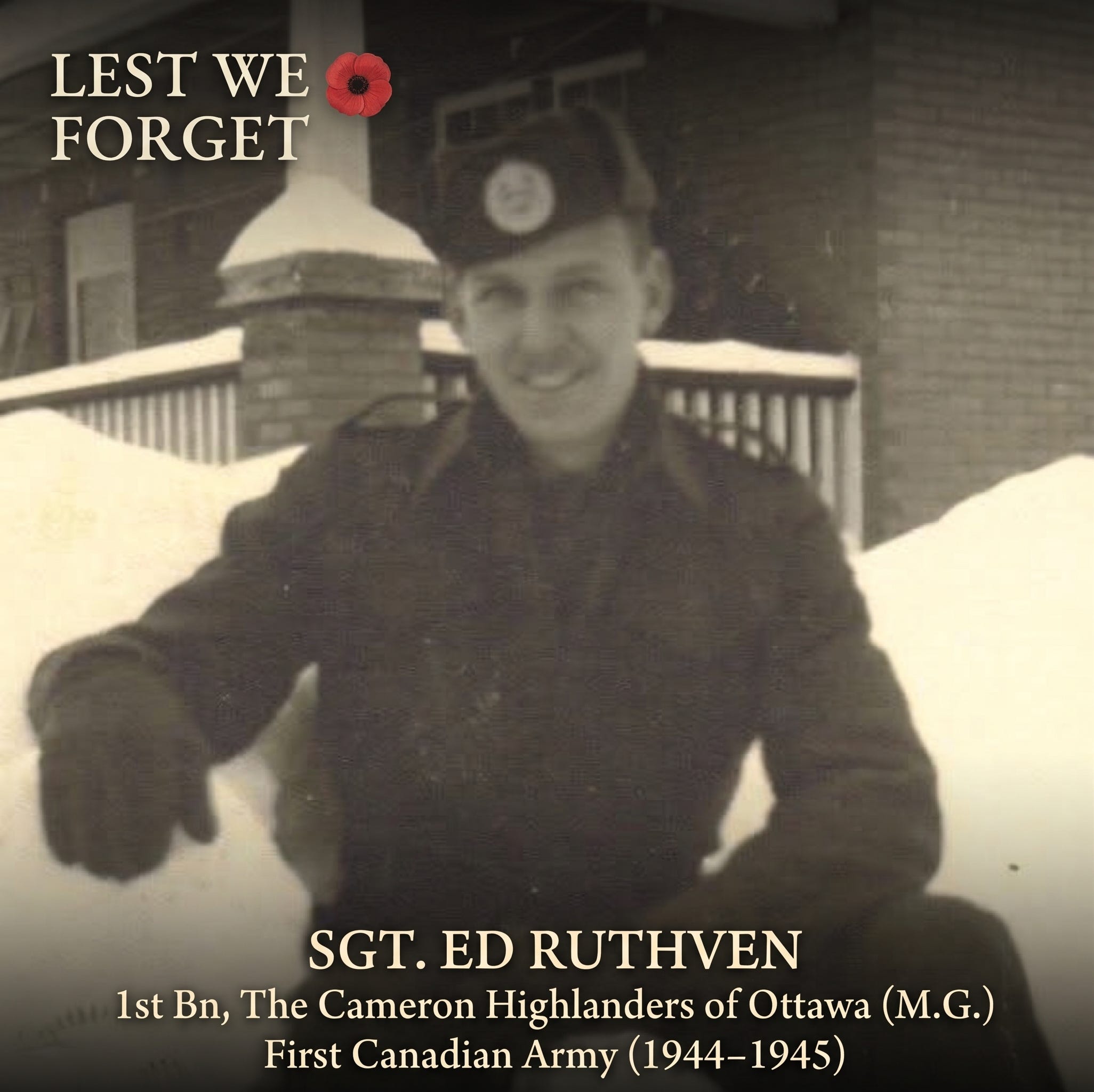
Most men who lived through the Second World War locked it behind a lifetime of silence. They came home to Canada, hung up their wool uniforms, found work, married, and built post-war life. My grandfather, Sergeant Ed Ruthven of the 1st Battalion, The Cameron Highlanders of Ottawa (M.G.), was one of those men. To most people he was a gentle, unassuming man with warm eyes and a quiet grin.
To me, he was my hero, my best friend and my whole world, and we did everything together. Out in the quiet bush of Muskoka, Ontario, Canada he taught me to shoot, not with a combat veteran’s bravado but with the patient, steady hands of a grandfather who understood the finality of a trigger and the value of discipline. When I was in Grade 9, proud of who he was, I asked him to come and speak to my history class. I wanted him to stand before thirty teenagers and tell them what the front lines of Western Europe had really been like.
He told me he could not do it. That door was shut to the public, to the school boards and to the legion halls. Yet he opened it to me, and I will hold that with reverence for the rest of my life. Sitting together, he told me about the black mud, the concussive slam of high explosives, and the faces of young men swallowed by the smoke.
He walked through hell and it cost him. Even decades later, telling me those stories left him sleepless, caught in vivid waking nightmares. Half a century had not dimmed the glare of burning cities or the smell of cordite. He could still see it all, down to the inch.
The King in the London Fog
My grandfather’s war began in the blackout camps of Britain, long before the landing craft reached Northwest Europe. The 1st Battalion of the Cameron Highlanders of Ottawa moved to Great Britain in April 1941, after garrison duty in Iceland. He told me of one afternoon on sentry duty at Buckingham Palace, when one of London’s thick “pea-souper” coal fogs rolled in and turned the air into a grey wall. Straining to see, he missed the muffled signal for the rifle salute, caught sight of the sentry across the walkway snapping into motion, and brought his Lee-Enfield up in a sharp, late salute.
As the rifle swung back down, a figure stepped out of the fog and walked straight into him. His reflexes took over, and he caught his rifle before it could clatter onto the cobblestones. Looking up through the mist, he found himself face to face with King George VI. There was no rebuke and no court-martial: the King shook the young Canadian’s hand warmly and said, “I’m sorry, sir. That was a good catch.”
That humility left its mark on my grandfather for the rest of his life. In his leather wallet, beside photographs of his family, he carried a 1937 Bank of Canada one-dollar bill bearing the King’s portrait. It was his private keepsake of the day a King apologized to a young man from Ontario.
The Water Rats and the Vickers Guns
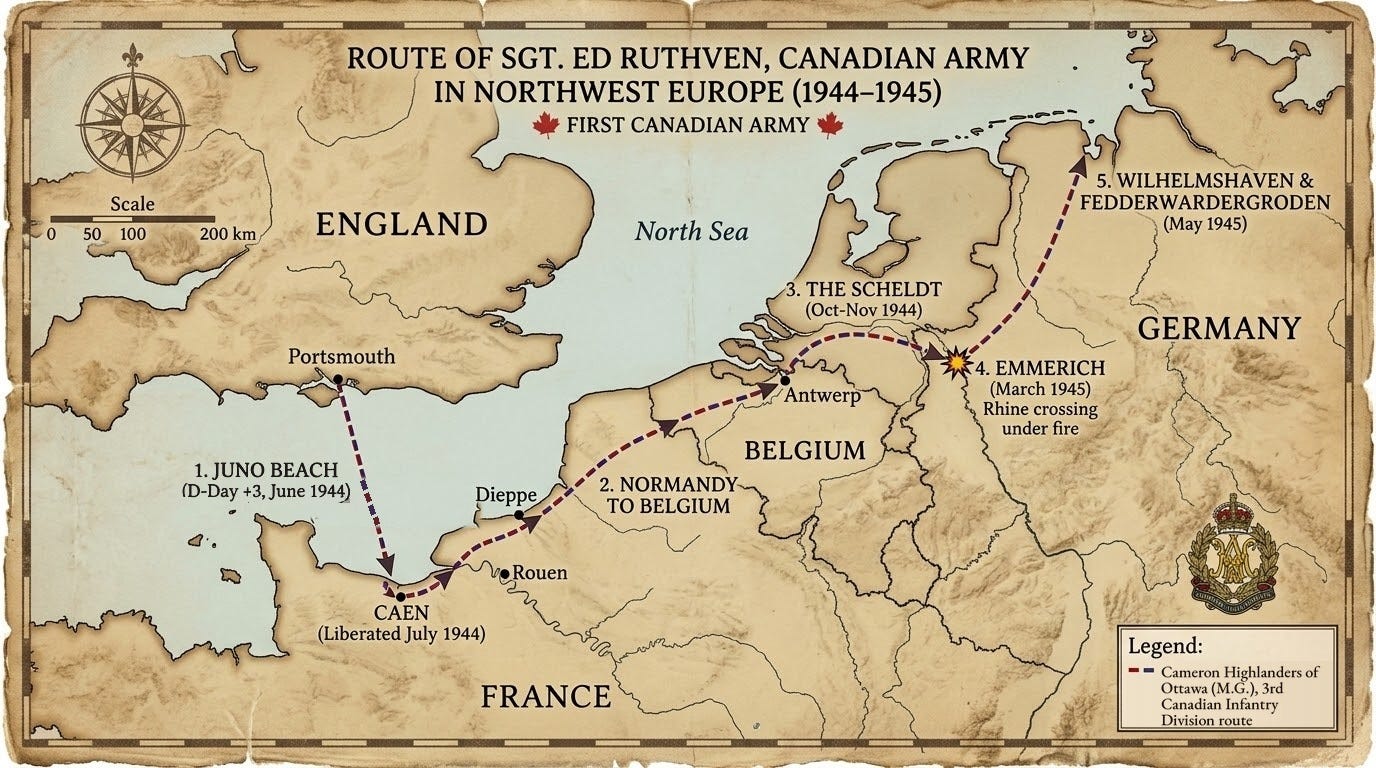
When the invasion came, my grandfather did not go forward as an ordinary rifleman. He served in No. 3 Company, supporting the 9th Canadian Infantry Brigade, and his battalion was the machine-gun support unit of the 3rd Canadian Infantry Division, organized around three Vickers medium machine-gun companies and a 4.2-inch mortar company. They were the division’s heavy support: while the rifle companies pushed ahead with light equipment, the Camerons operated the water-cooled Vickers .303 and the heavy mortars. Mounted in tracked Universal (Bren) Carriers, their job was to lay sustained fire over the heads of advancing infantry and break German counterattacks before they could form.
That firepower also made Cameron positions a target for German artillery. The 1st Battalion landed in Normandy on June 6, 1944, as part of the Canadian D-Day assault force, and my grandfather came ashore at Juno Beach with his Bren gun carrier three days later, on June 9, 1944. The division was then sent into the wettest, grimmest ground in Northwest Europe. In the flooded dykes and sunken polders of the Scheldt in the autumn of 1944, men waded waist-deep in freezing salt water where tanks sank and boots rotted.
Field Marshal Bernard Montgomery gave the 3rd Canadian Infantry Division a name for that fighting: the Water Rats. It was a nod to his “Desert Rats” of North Africa, earned instead in the cold grey mud of the Low Countries. That was my grandfather’s war, fought in the muck, where a broken track left a crew exposed in an open steel box.
The Minefields of Caen and the Hay Loft
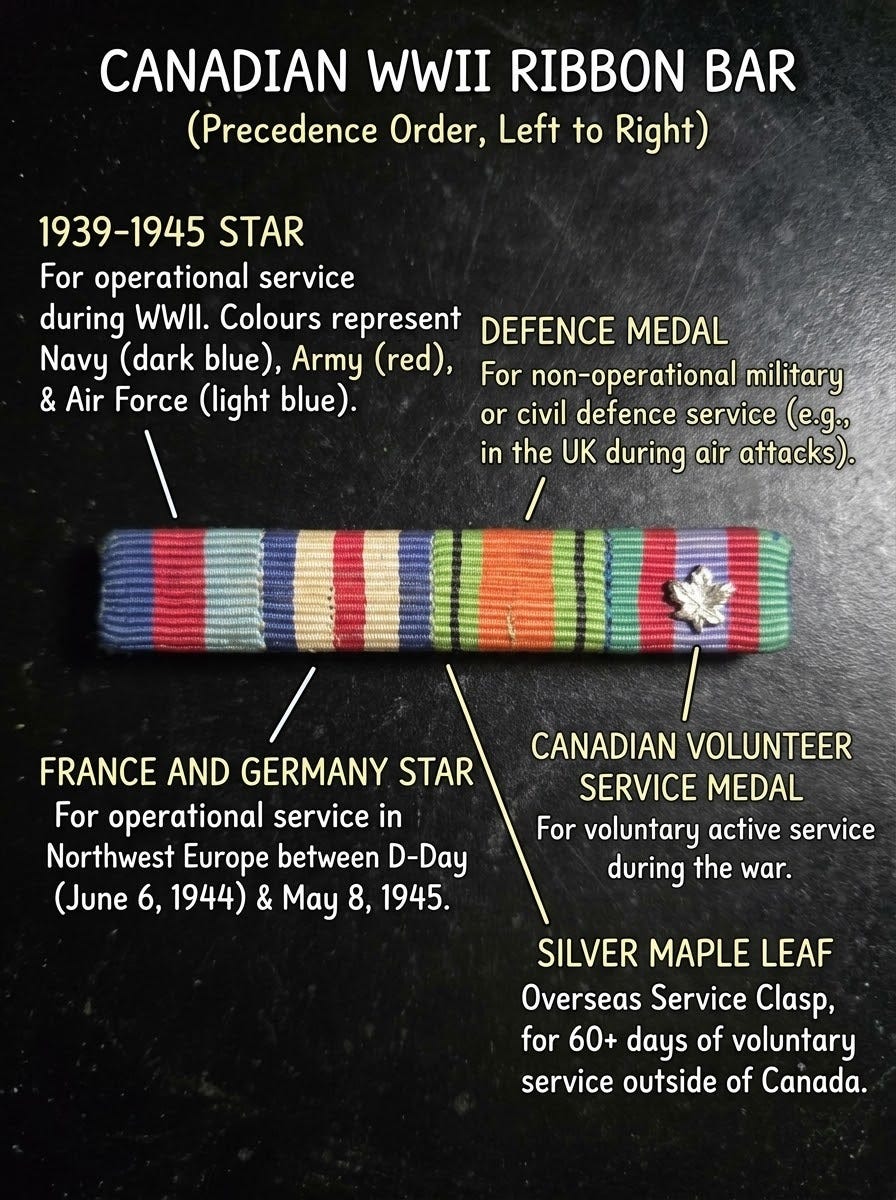
In the push toward Caen in the summer of 1944, his carrier section ran into a German defensive belt sown with anti-tank and anti-personnel mines. Vehicles were being torn apart around them, with road wheels and carrier bogies blown into the hedgerows. In the smoke and chaos, my grandfather was one of the few who could read the ground. Looking for subtle depressions, disturbed sod and old vehicle ruts, he found the safe seams through the minefield and guided his carriers through intact, where an error of inches would have ended it.
Caen itself was nearly gone by the time it was taken. On the evening of July 7, 1944, on the eve of Operation Charnwood, he watched 467 Lancaster and Halifax bombers of RAF Bomber Command drop more than 2,000 tons of bombs on the north of the city. Most of those bombs fell on Caen rather than on the German positions beyond it, and much of the northern city was reduced to chalky dust and ash.
Every mile gained came with close calls. Pushing through a French farm, he climbed into a barn loft to look out a window and see how far the retreating Germans had fallen back. A German sniper, trained to watch high vantage points, put a round into the wooden windowsill inches from his head. He said he never moved faster in his life than he did coming down from that loft.
Psalm 91:7
As the Canadians moved across northern France, death came out of clear skies and quiet roads alike. One day, marching on foot between towns, four of them were walking together behind an army truck. Without warning, a lone German fighter dropped out of the sky on a low-level strafing run and raked the road with cannon and machine-gun fire. In an instant, the burst killed the soldier walking at my grandfather’s left and the captain walking at his right. Only my grandfather, standing between them, and the soldier on the far right walked away alive.
It was not the only time he stood at the centre of the storm and came through untouched. During a night stop between ruined towns, a German battery fired an interdiction salvo that fell short and landed directly in their bivouac. My grandfather was resting beside an army truck when the shell detonated and threw jagged steel outward in every direction. The soldiers sheltering at the other three corners of the truck were killed instantly, and he did not receive a scratch.
Through every bombardment, strafing run and close call, he held to one verse, Psalm 91:7: “A thousand may fall at your side, and ten thousand at your right hand; but it shall not come near you.” For him, those words were literal. He had seen a man fall at his side and an officer fall at his right hand, and he was kept standing. It was not arrogance but a prayer, whispered through clenched teeth while the ground heaved, and it became his armour.
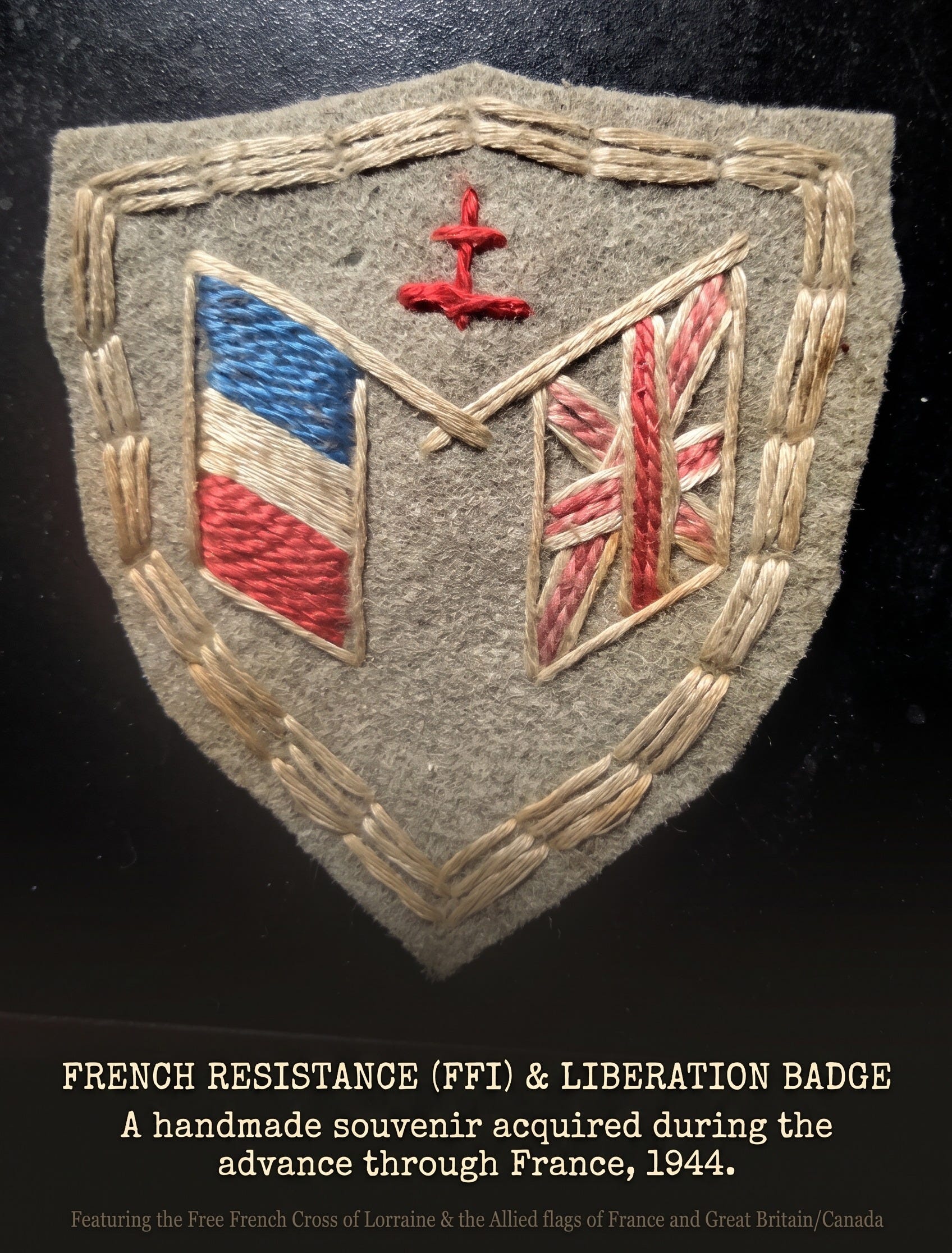
Amid that slaughter, moments of human warmth broke through. Somewhere in France, a civilian or a resistance fighter handed him a handmade badge: a cloth shield, hand-embroidered with the red Free French Cross of Lorraine and the crossed flags of France and Britain. It was a token of liberation, stitched by hands that had endured four years of occupation, and it stayed in his kit bag all the way to Germany.
The Rhine, the Log Pile and a Rescued Stray
In late March 1945, the 9th Brigade crossed the Rhine in Operation Plunder and fought in the bridgehead near Rees before turning north to Emmerich. The floodplain was a churned quagmire of silt and mud. As his carrier came up the far bank, its tracks lost traction and it bogged down in the open, in full view of the enemy. German artillery opened on it from three sides. With the open-topped carrier now a shrapnel trap, my grandfather threw himself out into the mud and dove headfirst under a pile of felled timber, where he lay pinned while the shells came in and the logs splintered above him.
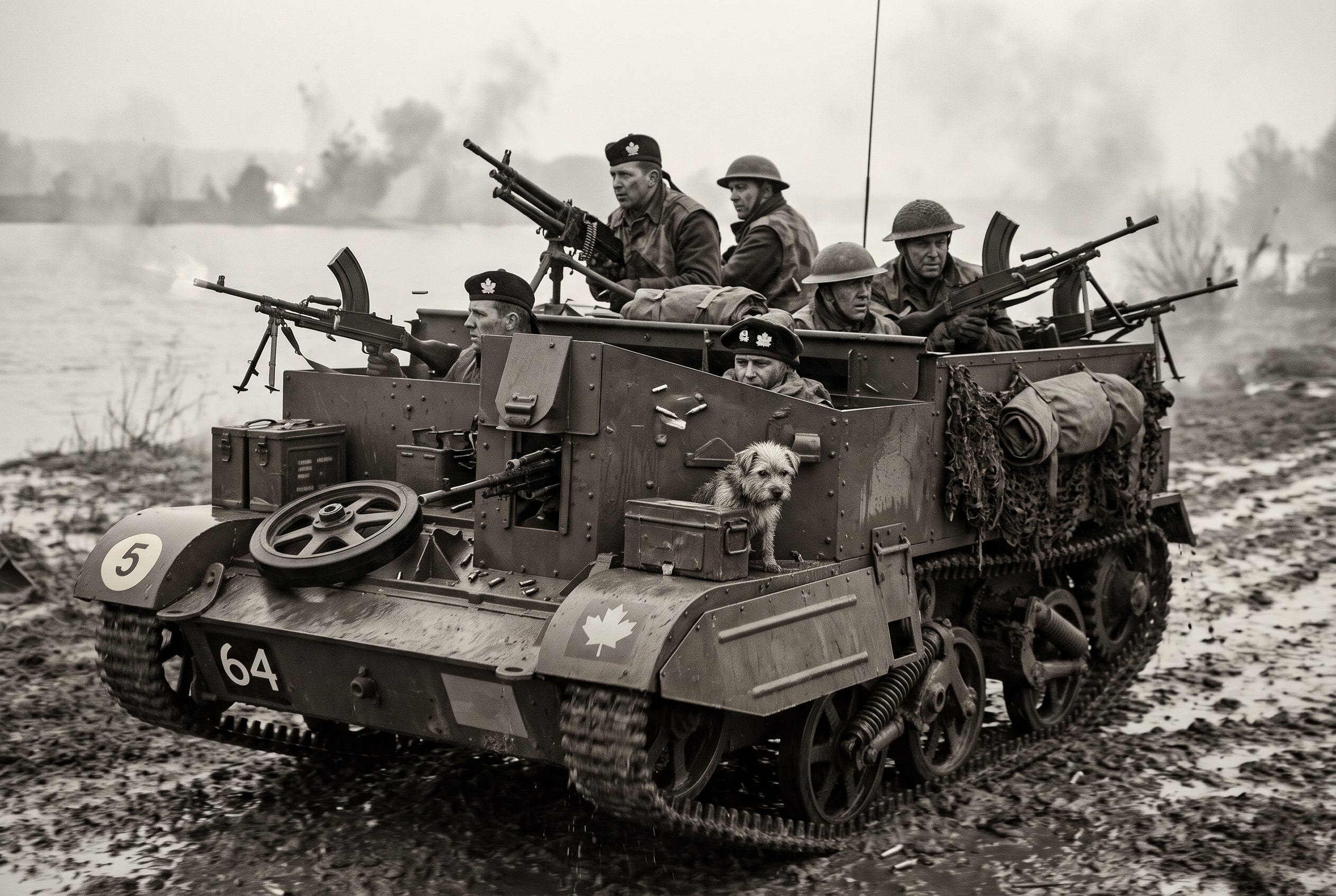
He was not alone in that carrier. Somewhere along the shattered roads of France and Holland, he had rescued a little stray dog. That scruffy terrier mix became a permanent member of the crew, riding into battle, eating army rations and giving warmth to men who had little of it left.
A True Sergeant’s Heart
Several times during the campaign, his commanding officers recognized his composure under fire and his steady navigation of the minefields. More than once they tried to give him a field commission and pin a lieutenant’s pips on his shoulders, and every time he refused. A commission would have meant a new platoon, a place back at the command tents, and orders to send young men forward into machine-gun fire. His place was in the mud, behind the gun and beside his boys: he wanted none of the prestige and all of the responsibility, and his only ambition was to bring as many of them home alive as he could.
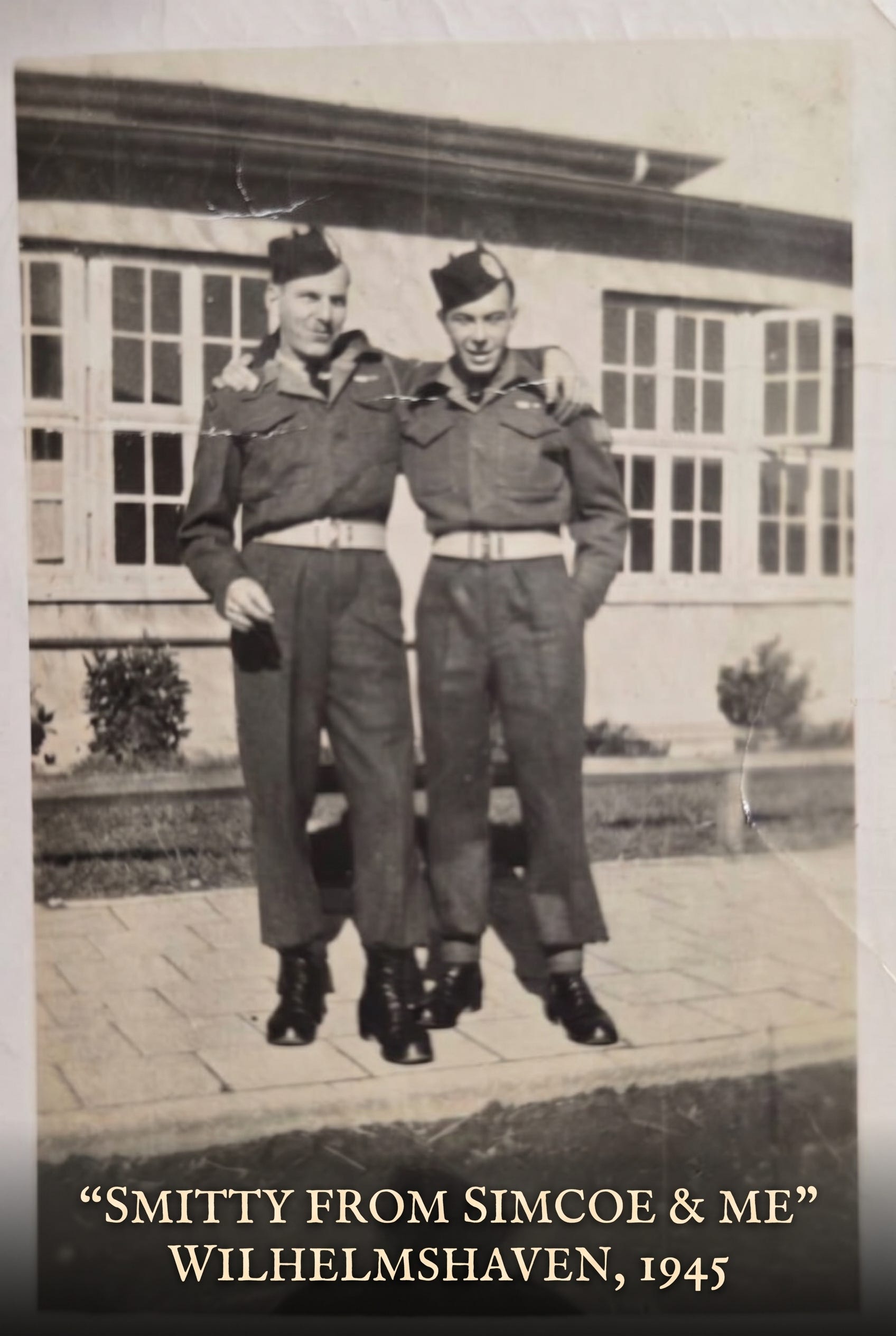
When the war in Europe ended in May 1945, his unit was near the naval port of Wilhelmshaven. There, in clean summer uniforms and polished white web belts, he posed for a photograph with his friend “Smitty from Simcoe,” two Ontario soldiers who had walked through the fire together and survived.
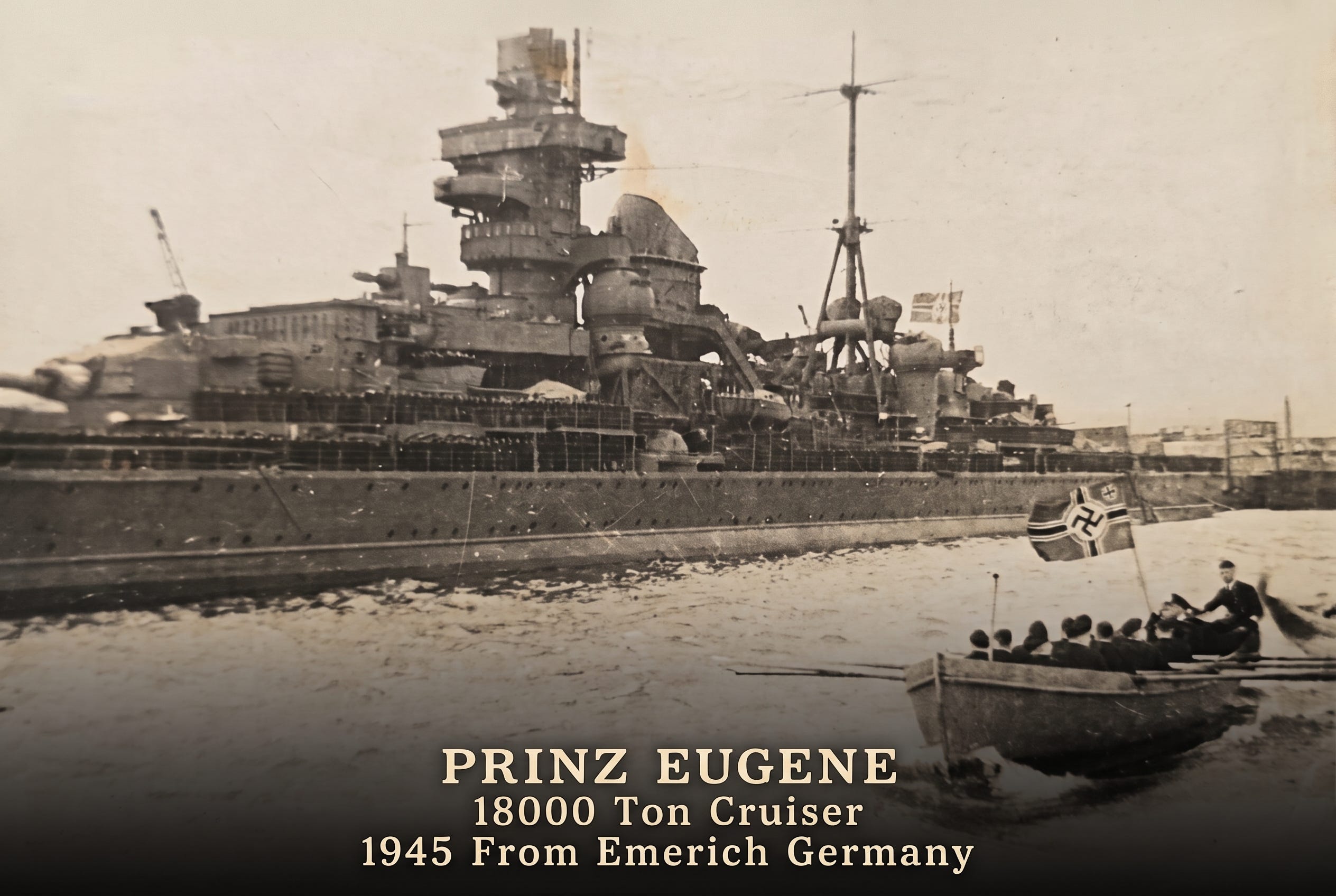
At Emmerich, he came away with a photograph of the German heavy cruiser Prinz Eugen, a ship of some 18,000 tons. On the back, in his own hand, he noted that she was “Delivered to Russian Navy” and that the photograph came “From Emerich” in 1945. That was what he understood at the opening of the Cold War. The record shows she went to the United States Navy instead and was used in the 1946 tests of the atomic bomb at Bikini Atoll.
When the ships began carrying Canadian soldiers home, Sgt. Ruthven was not among the first to go. For six months after the German surrender, he remained in the Netherlands, among a people who had come through the Hunger Winter and were rebuilding their country. Having fought through their flooded fields as a Water Rat, he saw that rebuilding begin. In 1945, the Dutch royal family sent 100,000 tulip bulbs to Ottawa in thanks for Canada’s shelter of their family during the occupation, and the tulips still bloom there every spring. When I see them, I see him.
Evelyn, Home, and Christmas Morning 1996
When he finally came home, it was his beloved wife, Norma Evelyn Humphrys, known to us as Eve or Nana, who became his rock, his sanctuary and the centre of his peace. As soon as he stepped off the train in Toronto they were determined to get married. They married on July 19, 1948, in Huntsville, Ontario, beginning a life together that lasted until his death on Christmas morning 1996. Through the silent nights when Europe crept back in, her steady grace and devoted love anchored him. Together they built the quiet, beautiful life he had fought to protect, raised their family and weathered every storm side by side, and they celebrated their 40th (Ruby) wedding anniversary on July 19, 1988. Their children, and the grandchildren who came after, are alive because a young sergeant made it home from the mud.
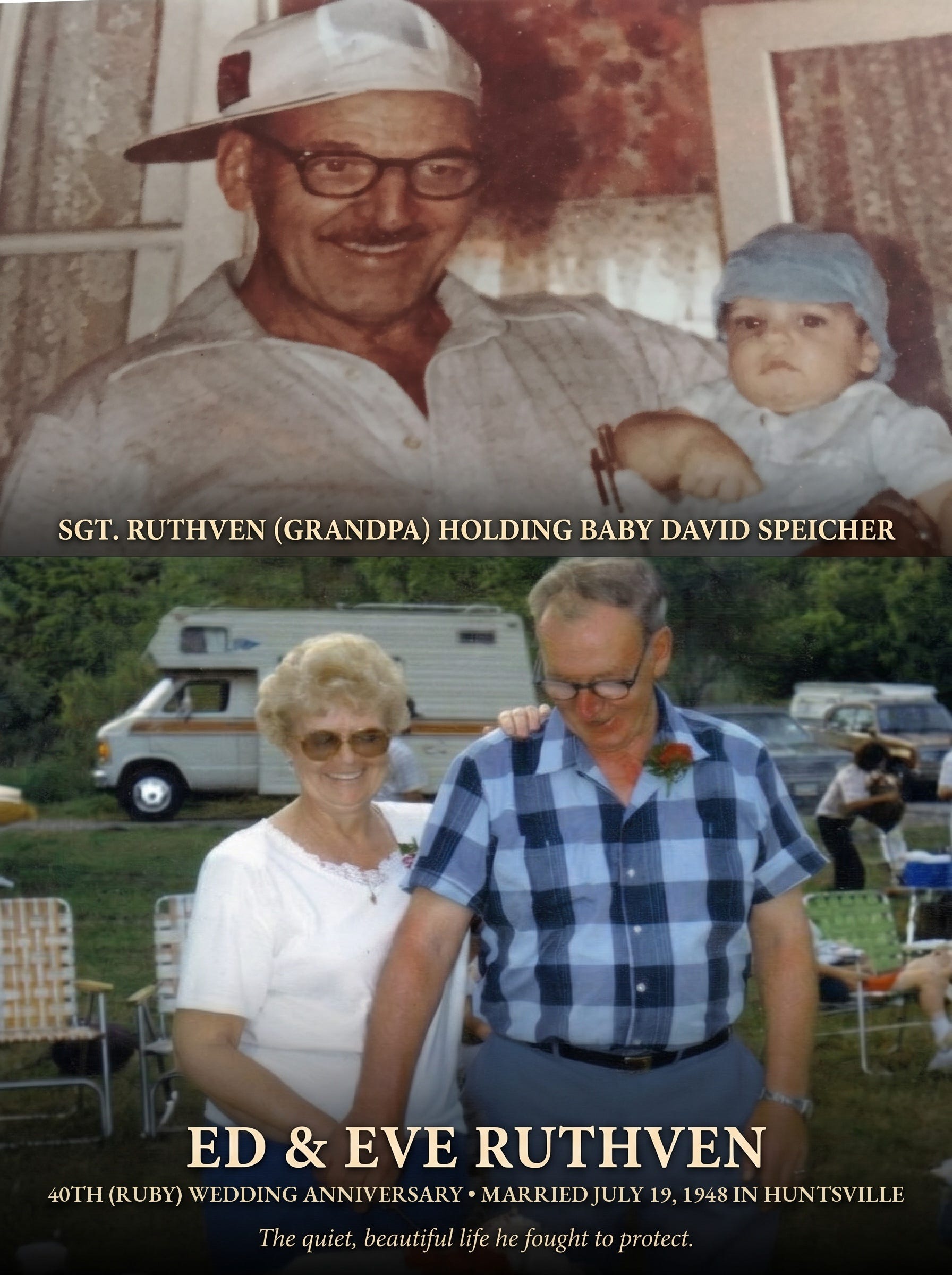
The war ended in 1945, but for my grandfather it never fully let go. It lived in the quiet pauses between his sentences, in his sharp flinch at a sudden noise, and in the nightmares that haunted his sleep. On Christmas morning, December 25, 1996, at 7:50 a.m., my world shattered. I walked into his room and found him gone, taken by a sudden heart attack.
I am crying as I write these words, because the ache of missing him does not fade with time. The hands that gripped a Vickers machine gun, caught his rifle in the London fog, guided young men through the minefields of Caen and held Eve’s hand through decades of marriage were the same gentle hands that held me as a baby. They taught me how to shoot, and they loved me without condition.
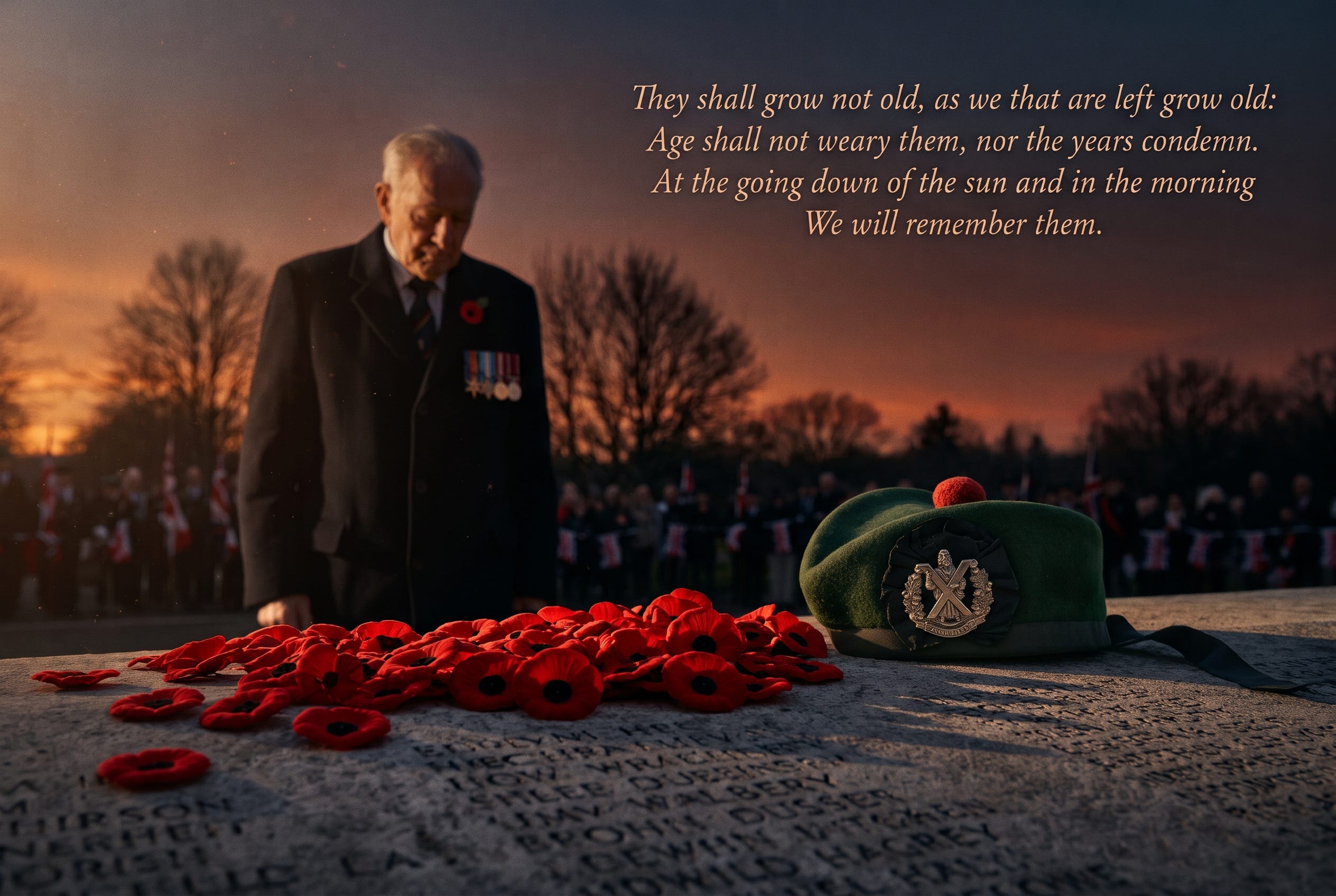
On this Remembrance Day, as the bugles sound across our quiet cenotaphs, we repeat the promise: Lest we forget. For Sgt. Ed Ruthven, forgetting was never an option, and he carried the cost of our freedom in the silence of his soul until his last breath. Through his stories, his courage, his deep humility and the mercy that walked at his right hand, we make sure he is remembered. The freedom he defended is ours to keep.
What Freedom Costs
My grandfather never spoke of freedom as an idea. He knew its price in the friends he left behind in the mud of France, Belgium, the Netherlands and Germany. Over the past six years, Canadians have watched freedoms they took for granted fall away: churches closed their doors, livelihoods were tied to a medical choice, and those who asked questions were silenced. We have too easily forgotten what freedom costs, and how quickly it is lost when no one stands guard.
Even now, our governments press for what I hold to be morally wrong. Bill C-9, the Combatting Hate Act, became law on June 18, 2026, and in my assessment it threatens free speech and religious expression. Ottawa is reviewing how firearms are classified, a review that could widen the bans on rifles that law-abiding Canadians own. Meanwhile, in my view, too many repeat offenders are released back onto our streets.
Standing guard today does not take a Vickers gun. It takes the courage to question everything and to follow the measured evidence, as I have tried to do in my own research on residual DNA in the COVID-19 modRNA vaccines. It means following the science and the silenced. Above all, it means defending the weak: the vaccine-injured and their families, who have too often been dismissed and left to carry their burden alone. My grandfather spent his war protecting the men beside him, and on this Remembrance Day, we are called to do the same for those beside us.
Support Independent Scientific Oversight
Scientific data and regulatory records belong in public view. All of our core genomic findings, peer-reviewed data and regulatory analyses will remain free and accessible to the public.
Independent molecular testing, and the work of preserving and publishing the record, require independent funding. If you value this work, please consider upgrading to a paid Substack subscription. Your support keeps this work free for the families, clinicians and lawmakers who use it.
Deploy the Blueprint & Hold the Line
Share the Evidence: Send this post to someone whose family member served. Ask them to write down one of that person’s stories before it is lost.
Join the Conversation: Who in your family served, and with which unit? Post their name and regiment in the comments below.
Strategic Funding: To support our independent laboratory work directly, send an e-transfer to support@davidspeicher.com or contribute through my GiveSendGo campaign.
Advisory Engagements (Cyrus Scientific Inc.): As Chief Scientific Officer and Founder of Cyrus Scientific Inc., I take on retained advisory engagements in three areas: expert advisory for legal and policy matters, assay and R&D advisory, and regulatory and data review advisory. For advisory inquiries to Cyrus Scientific Inc., write to research@davidspeicher.com.
Monitor the Intelligence: Follow my updates on X (@DJSpeicher), and follow the Cyrus Scientific and Dr. David Speicher pages on LinkedIn.
Amazing 👏 tribute to your grandfather, Sergeant Ed Ruthven of the 1st Battalion, The Cameron Highlanders of Ottawa (M.G.)
I salute the service provided by your grandfather and all those who never made it home after WWII ended. Many thanks to all their efforts.
Wonderful story about the run-in with King George VI. I recently was reminded of how hideous those London coal pea soup fogs were on a walking tour by a demonstration of how difficult walking along a London street became. You literally could not see anything past a few feet, sometimes you couldn't see your own hand stretched out in front of you.
PTSD is all too real and unfortunately the trauma may be forgotten while awake but not while asleep. For your grandfather, it may have been a survivors guilt of why me over a quiet Christmas 🎄 Eve and into the Christmas morning 🌄. My condolences on your loss and thank you for sharing on the Veterans (Remembrance) day Nov 11th.
For the present, all of us have been living with the consequences of being injected with an unknown substance promised as being “safe and effective” and have found out the hard way that the covid vaccines quite simply were not safe or effective at all. Now more mRNA based flu shots and other hideous graphene based injections have been concocted and are being planned for mass injections again.
Be sure to read for example
https://www.thefocalpoints.com/p/breaking-reports-of-serious-injuries
Moderna’s newly approved mRNA flu injection, mFLUSIVA (mRNA-1010), already accumulated 78 reports in the Vaccine Adverse Event Reporting System (VAERS) through the October 30, 2026 data release.
Among them are accounts of sudden inability to walk, partial vision loss, cardiac arrhythmias, fainting, and hospitalization.
Oh dear. Our good health appears to have become the new target of someone else's war. Detox, rest, connect with your neighbors, friends, community to stay strong and above all,
Stay calm and carry on.
Cheers