

A compound that no database can name is still in the product. It does not become safe by being unidentified, and it does not become absent by going unmeasured. That is the plainest way I know to put what I came to say at High River, and it is the sentence I would keep if I had to throw the rest away.
From August 18 to 20, 2026, the National Citizens Inquiry held hearings in High River, Alberta, answered this question on the record: “Are Farmers Safe in Canada?” The hearings covered supply management, food security and farmland conversion. I was there to talk about something narrower and, to a dairy farmer, more immediate: what is actually in the protein now being sold as milk without a cow, and who has measured it.
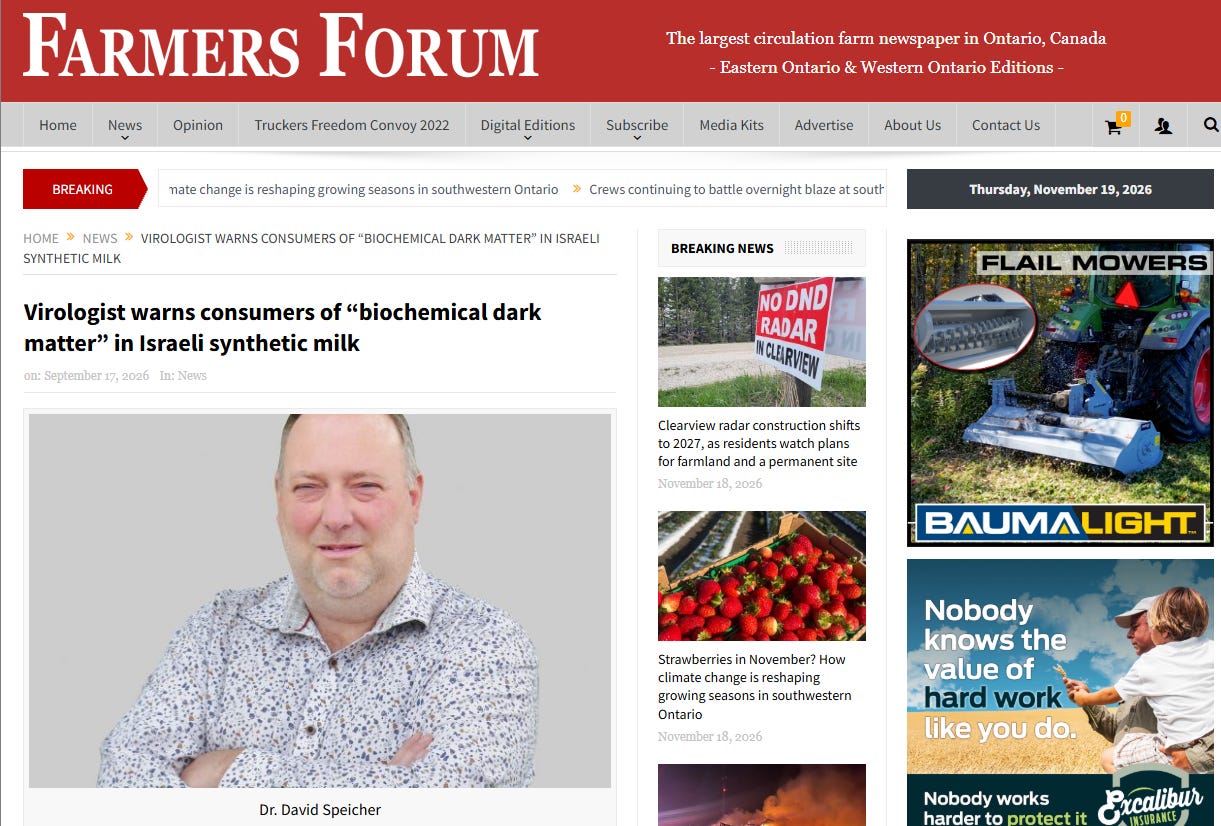
Three weeks later, on September 17, 2026, Farmers Forum published Nelson Zandbergen’s account under the headline “Virologist warns consumers of ‘biochemical dark matter’ in Israeli synthetic milk.” The dark matter is real, and it is measurable. The thing that lets it stay unmeasured is a rule, and the rule has a name.
“Any Person May Notify Us”: What GRAS Actually Means
Generally Recognized As Safe (GRAS) is a category created by the Food Additives Amendment of 1958. A food additive needs premarket approval; a substance that is generally recognized as safe does not. The whole weight of consumer protection therefore rests on who does the recognizing.
The answer is in the Federal Register. In its final rule on Substances Generally Recognized as Safe, published on August 17, 2016 at 81 FR 54960 and effective on October 17, 2016, the FDA replaced its earlier petition process with, in the rule’s own words, “a voluntary notification procedure under which any person may notify us of a conclusion that a substance is GRAS.” Read that twice. The conclusion belongs to the notifier. Telling the regulator about it is voluntary.
The rule made one small change that says everything. The FDA replaced the words determine and determination with conclude and conclusion, because the company is not determining anything in a regulatory sense. It is reaching its own view, under a standard the rule states as being “generally recognized, among qualified experts, to be safe under the conditions of its intended use.” A company may convene its own panel of qualified experts, reach its own conclusion, and sell the product. If it chooses to file a notice, the FDA’s most favourable possible reply is that it has no questions, which is not the same as agreement and is not approval.
Velamuri and colleagues make the same point in their own paper, and they quote the document that settles it. The FDA’s letter of response to this developer’s GRAS declaration states, in the authors’ quotation, “This letter is not an affirmation that beta-lactoglobulin is GRAS under…”. The authors add that the protocol “essentially leaves pre-market safety assessments to the discretion of product developers”, and that in recent years products have begun to enter the market without participating in the FDA process at all.
This is what people mean by self-affirmed GRAS. It is not a theory about a hidden loophole; it is the published mechanism, in the regulator’s own document, available to anyone who wants to read it. Nothing about it is secret, and that is precisely why the argument is worth making in public rather than in insinuation.
Two consequences follow, and both matter to a farmer. The first is that a novel protein made in a fungus can reach a grocery shelf without any government scientist having examined a single lot of it, while the dairy beside that shelf is tested, inspected, quota-managed and licensed. The second is subtler and worse. Where a company does not file a notice, there is no public document at all. No dossier, no reviewer’s comments, no record of what was tested and what was skipped. A food can be in the supply chain and leave no regulatory paper trail that a citizen, a clinician or a Member of Parliament can request.
What Three Methods Found When Someone Finally Looked
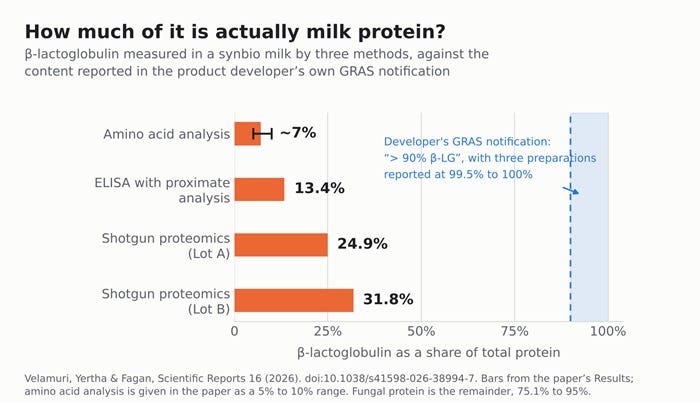
Last spring someone looked. Velamuri, Yertha and Fagan published a multi-omics analysis in Scientific Reports on April 3, 2026 of a synbio milk containing recombinant bovine β-lactoglobulin produced in the fungus Trichoderma reesei. They asked how much of the product is the protein it claims to be.
The developer’s own GRAS notification, which the authors quote, reports the product as “> 90% β-LG”, with three preparations reported at 99.5 to 100 per cent. Three independent methods found something else entirely. Amino acid analysis put β-lactoglobulin at around 7 per cent. ELISA with proximate analysis put it at 13.4 per cent. Shotgun proteomics, run on two separate lots, put it at 24.9 per cent in Lot A and 31.8 per cent in Lot B. The authors’ summary is that fungal protein makes up the bulk of the protein in the product, from 75.1 to 95 per cent depending on the method.
The three methods do not agree with each other, and the paper does not pretend otherwise. They span roughly 7 to 32 per cent β-lactoglobulin. What they agree on is the direction, and the distance from the figure in the notification is larger than the distance between them.
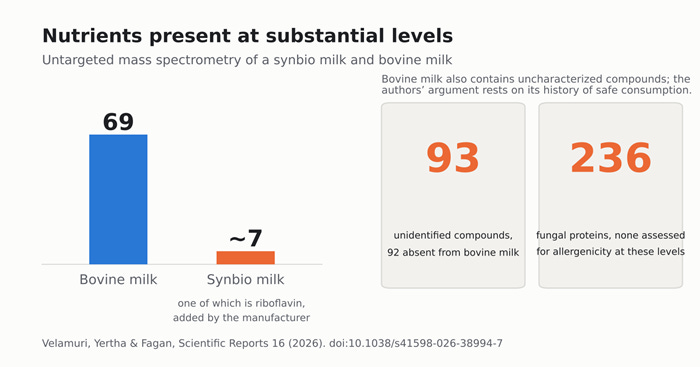
The nutrition comparison is where a farmer’s instinct turns out to be right. Untargeted mass spectrometry identified 69 nutritional compounds in bovine milk, of which only about 7 were found in the synbio product, all at levels much lower than in bovine milk. One of those seven is riboflavin, which the authors note was added deliberately by the manufacturer and appears on the nutrition label. The same analysis found 93 unidentified molecules in the synbio product, 92 of them absent from bovine milk, alongside the 236 fungal proteins in the paper’s title, of which the authors say none has been assessed for allergenicity at the multi-gram exposure levels that a serving involves.
The authors are careful here in a way worth repeating. Bovine milk also contains many compounds that science has not characterized; untargeted metabolomics finds unknowns in almost any biological material. Their argument is not that unknown equals dangerous. It is that bovine milk’s unknowns come with centuries of human consumption behind them, and the synbio product’s unknowns come with none.
One correction to my own share of the record, because precision matters more than a headline. That paper tested a Trichoderma product and names no company. Health Canada’s Canadian clearance is a different organism: its Novel Food Information document on β-lactoglobulin from the yeast Komagataella phaffii yRMK-66, published on January 31, 2024, records that Health Canada notified Remilk it has no objection, concludes that the review “does not raise concerns related to food safety,” and limits its opinion to “the food use of r-βLG produced from K. phaffii yRMK-66.” The host organism determines which proteins and byproducts travel with the target protein. So the 236 fungal proteins are not Remilk’s figure, and the Canadian product’s own accompanying proteins and metabolites remain, in the published literature, uncounted.
Artificial Eggs, Salmon, and Butter
Milk protein is not the only product on this pathway. Recombinant egg white protein grown in yeast and fat built from carbon dioxide are both being brought to market by the same route. Take the fat: the Californian company Savor makes butter from point-captured carbon dioxide, hydrogen and methane, converting gases into alkanes and then into fatty acids and triglycerides under heat and pressure.
I want to be exact about the regulatory status, including where my own checking ran out. Trade reporting in March 2025 states that Savor self-affirmed its butter as GRAS and was then seeking a no-questions letter from the FDA, with its chief executive quoted as planning to submit the dossier. If that reporting is accurate and still current, a fat made by a route that has never been part of the human food supply is on sale in the United States on the strength of the manufacturer’s own conclusion, with the regulator not yet having said anything at all. That is the mechanism working exactly as written.
The seafood analogues sold as printed salmon are largely mycoprotein products on the European market, which is a different regulatory system from GRAS and should not be called GRAS-approved without checking each one. A “no questions” letter, where a company does obtain one, records that the agency has no questions about the notifier’s conclusion, which is a narrower statement than approval, and the letter says so in its own words. The fact that a scientist with research-library access cannot readily establish what has been filed for products already being sold than how can any shopper be able to know if what they are buying is actually safe.
8,334 Children: The Food That Has Been Measured
Set against all of this is a food that has been studied in detail, in large numbers, for decades, and is restricted in Canada.
In the GABRIELA study, Loss and colleagues reported in the Journal of Allergy and Clinical Immunology in 2011 on 8,334 school-aged children in rural Germany, Austria and Switzerland, with 7,606 serum samples and 800 milk samples collected at the participants’ homes. Reported raw milk consumption was inversely associated with asthma (adjusted odds ratio 0.59, 95% CI 0.46 to 0.74), atopy (0.74, 0.61 to 0.90) and hay fever (0.51, 0.37 to 0.69), independent of other farm exposures.
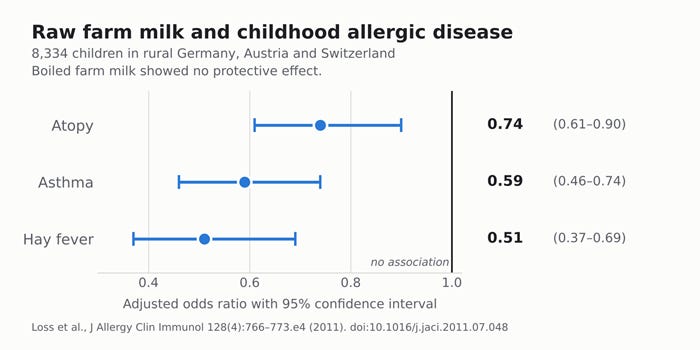
Two details in that paper deserve a farmer’s attention. Boiled farm milk showed no protective effect, which points to something heat-sensitive rather than to milk in general. Additionally, the constituents inversely associated with asthma were the whey proteins: bovine serum albumin, α-lactalbumin and β-lactoglobulin. That is the same protein now being grown in a fungus and sold on its own. The association in real milk sits with an intact, heat-sensitive matrix of proteins, and isolating one of them in a bioreactor is not the same thing as reproducing it.
These are associations in an observational cohort, not a trial, and the authors say so plainly. Raw milk also carries genuine microbiological risk that has to be managed on the farm, which is what the clean, cold, coaching and consumer-acclimation standards I set out at High River are for. Those standards are testable, and a dairy that follows them can publish its own plate counts and coliform results lot by lot.
That is the asymmetry I want farmers to hold on to. One product is studied in thousands of children, carries a risk that is understood and manageable, and is tightly restricted in Canada. Another is characterized in a single independent paper that found it was mostly something other than its label, carries 93 unidentified compounds of which 92 are absent from bovine milk, and reaches the shelf on a conclusion the seller reached in private. The honest comparison is not safe against dangerous. It is measured against unmeasured.
What Must Happen Next
There must demand an independent multi-omics audit of the β-lactoglobulin product cleared for sale in Canada with the methods used by Velamuri and colleagues. Publication of the toxicity and allergenicity testing those authors call for, at exposure levels matching real consumption. We also need a searchable, current, public register of every self-affirmed GRAS conclusion relied on for a product sold in Canada, so that a citizen can find out what has been concluded about their food and by whom.
None of these requires anyone to be found at fault. All three require complete transparency with the consumer.
Closing
I told the room at High River that a compound nobody can name is still in the product. I would put it differently now. The problem is not that someone hid the dark matter. The problem is that the rule never asked anyone to turn on the light. Ask for the measurement, on every product, including the one in your own tank.
References
1. Velamuri, R., Yertha, T. and Fagan, J. (2026) ‘Multi-omics profiling finds synbio milk differs nutritionally from bovine milk and contains 93 uncharacterized fungal metabolites and 236 fungal proteins’, Scientific Reports, 16(1). doi:10.1038/s41598-026-38994-7.
2. Loss, G., Apprich, S., Waser, M., Kneifel, W., Genuneit, J., Büchele, G., Weber, J., Sozanska, B., Danielewicz, H., Horak, E., van Neerven, R.J.J., Heederik, D., Lorenzen, P.C., von Mutius, E. and Braun-Fahrländer, C. (2011) ‘The protective effect of farm milk consumption on childhood asthma and atopy: the GABRIELA study’, Journal of Allergy and Clinical Immunology, 128(4), pp. 766–773.e4. doi:10.1016/j.jaci.2011.07.048.
3. US Food and Drug Administration. Substances Generally Recognized as Safe, final rule, 81 FR 54960, August 17, 2016, Docket No. FDA-1997-N-0020.
4. Health Canada. Novel Food Information: β-Lactoglobulin protein from yeast strain Komagataella phaffii yRMK-66. Published January 31, 2024.
5. National Citizens Inquiry. Media release: NCI High River, Alberta hearings, July 29, 2026.
6. Zandbergen, N. ‘Virologist warns consumers of “biochemical dark matter” in Israeli synthetic milk’, Farmers Forum, September 17, 2026.
Support Independent Scientific Oversight
Scientific data and regulatory records belong in public view. All of our core genomic findings, peer-reviewed data and regulatory analyses will remain free and accessible to the public.
Independent molecular testing, and the work of reading a product’s published analysis against the regulator’s own rule, require independent funding. If you value this work, please consider upgrading to a paid Substack subscription. Your support keeps these measurements and this analysis free for the families, clinicians and lawmakers who use them.
Deploy the Blueprint & Hold the Line
Share the Evidence: Send the Scientific Reports paper and the FDA’s 2016 GRAS final rule to your dairy association and your Member of Parliament. Ask which laboratory has run the same analysis on the β-lactoglobulin product cleared for sale in Canada.
Join the Conversation: The FDA’s rule lets any person notify it of their own conclusion that a substance is safe, and notifying is voluntary. What single change to that rule would you ask for first? Post your answer in the comments below.
Strategic Funding: To support our independent laboratory work directly, send an e-transfer to support@davidspeicher.com or contribute through my GiveSendGo campaign.
Advisory Engagements (Cyrus Scientific Inc.): As Chief Scientific Officer and Founder of Cyrus Scientific Inc., I take on retained advisory engagements in three areas: expert advisory for legal and policy matters, assay and R&D advisory, and regulatory and data review advisory. For advisory inquiries to Cyrus Scientific Inc., write to research@davidspeicher.com.
Monitor the Intelligence: Follow my updates on X (@DJSpeicher), and follow the Cyrus Scientific and Dr. David Speicher pages on LinkedIn.
"Milk without a cow" and other memorable phrasing :-) --and messages. All gratitude to you, Dr. Speicher.