

I have stuttered since childhood, and it has shaped how others treated me throughout my school years and career. I was severely teased as a child, and school-aged children can be cruel. In grade 12, a guidance counsellor advised me not to pursue university, on the grounds that my speech would prevent me from succeeding. I was determined to prove him wrong and went on to earn an MSc in Clinical Microbiology and a PhD in Virology at Griffith University in Australia. Even after my research on residual plasmid DNA and SV40 promoter-enhancer sequences in the COVID-19 modRNA vaccines was published, some podcast hosts and town hall organizers declined to have me speak about my own science because of my stutter. Nevertheless, I have never allowed my stutter to determine the limits of my work.
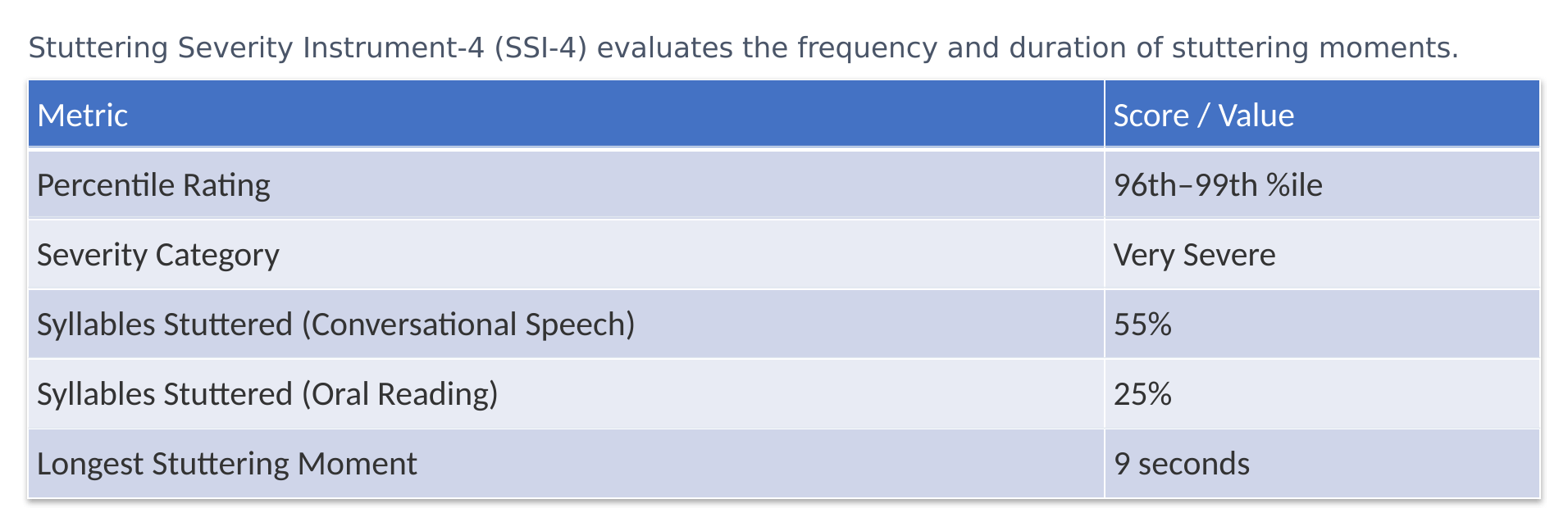
In 2018, I took an advanced course in the science of teaching and learning at the MacPherson Institute at McMaster University. There, I teamed up with speech-language pathologists on a small research study, “Speaking ability and teaching effectiveness,” in which the severity of my stutter was documented. On the Stuttering Severity Instrument (SSI-4), my stutter ranked in the very severe category, at the 96th to 99th percentile, with 55% of syllables stuttered in conversational speech. These figures establish the condition I have lived with daily. They also explain why changes in my speech were apparent to colleagues and others who know me well.
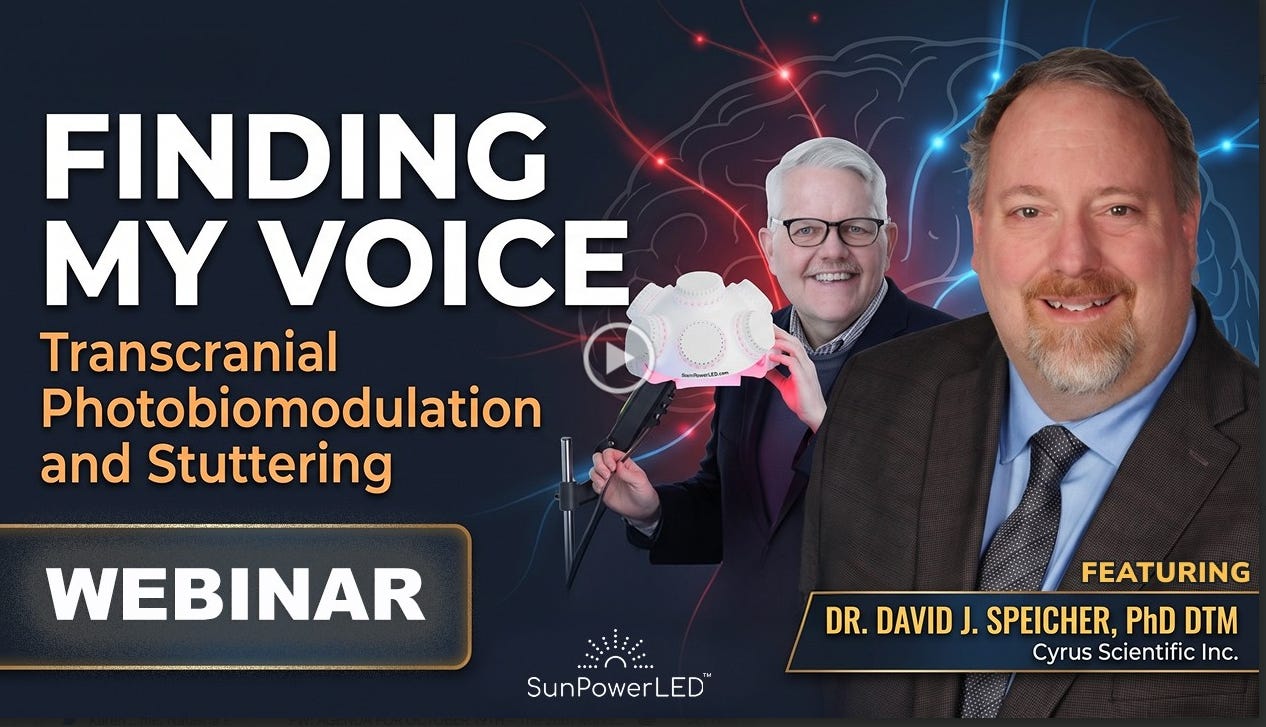
On October 13, 2026, after being on daily red-light therapy for nearly a year, I spoke about my stutter in a live webinar hosted by Tom Kerber of SunPower LED. I described my history, gave a live demonstration of transcranial photobiomodulation (tPBM), and presented the data from my single-person trial, with its limits. The full recording is now on YouTube.
Protocol and Observations
I began using SunPower LED’s transcranial helmet in November 2025. Each session applies two wavelengths in sequence: 660 nm red light, followed by 810 nm near-infrared (NIR) light. I initially used one minute of red and three minutes of NIR, increased the exposure to as much as five and ten minutes, and have since settled on three and nine minutes, which produces the same result for me as the longer exposure. The effect persists for approximately three days after a session and then gradually declines. After two weeks without treatment, my fluency is markedly worse.
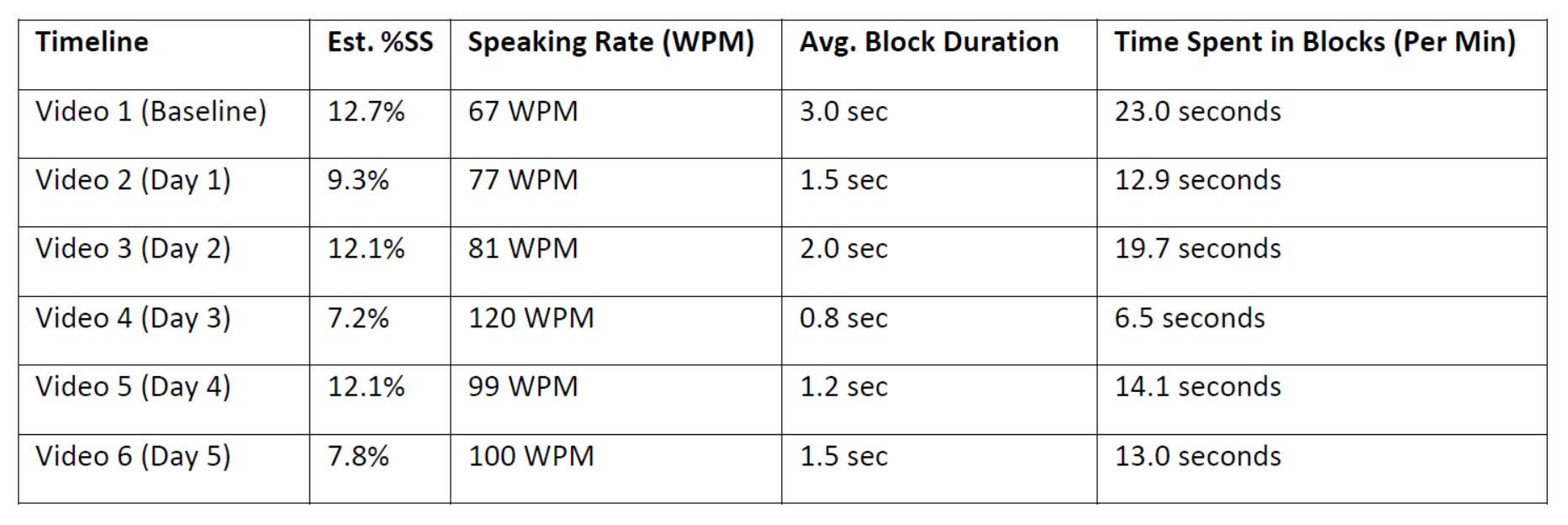
In March 2026, an unplanned comparison occurred. The helmet I was using was replaced, without my knowledge, with one fitted with 1050 nm NIR light, and my speech deteriorated progressively over that week. Once the substitution was identified, I recorded a baseline of my speech, returned to the 810 nm helmet, and recorded my speech after each daily session. Over the following five days, my estimated percentage of syllables stuttered fell from 12.7% at baseline to 7.8% on day five, and my speaking rate rose from 67 to 100 words per minute. The change was not linear: the percentage of syllables stuttered returned to 12.1% on days two and four.
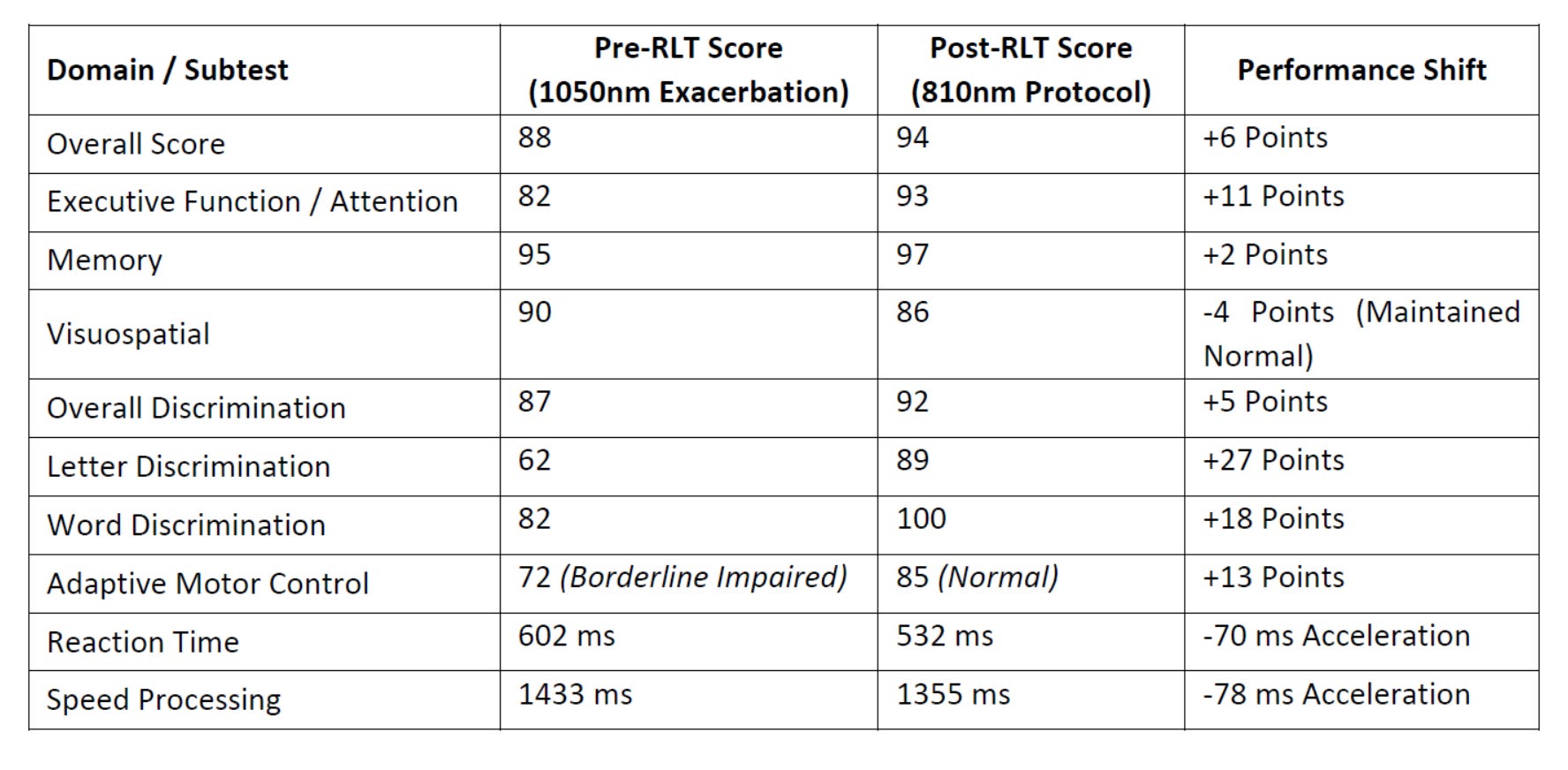
I also completed the Cognivue Clarity cognitive assessment twice: at the end of the 1050 nm week, immediately before returning to the 810 nm helmet, and again immediately after that first 810 nm session. On the second test, my scores were higher for executive function and attention (82 to 93) and for adaptive motor control (72 to 85), and my reaction time was faster, falling from 602 to 532 milliseconds. My visuospatial score dropped slightly, from 90 to 86. In plain terms, several measures of thinking and movement improved after a single 810 nm session, and one declined slightly. This was one person tested twice, with no control condition, so the results are suggestive and do not show that the light caused the changes.
The Pathophysiology of Stuttering
Developmental stuttering affects up to 5% of young children, between 75% and 90% of whom recover without formal therapy, and about 1% of adults continue to stutter [1]. It is understood to arise from several factors rather than a single cause. Family history is a well-documented risk factor, although at least half of all cases are not inherited. Mutations in GNPTAB, a gene needed for lysosomal function (the cell’s recycling system), have been linked to stuttering in a subset of families, and two related genes in the same pathway, GNPTG and NAGPA, may also contribute.
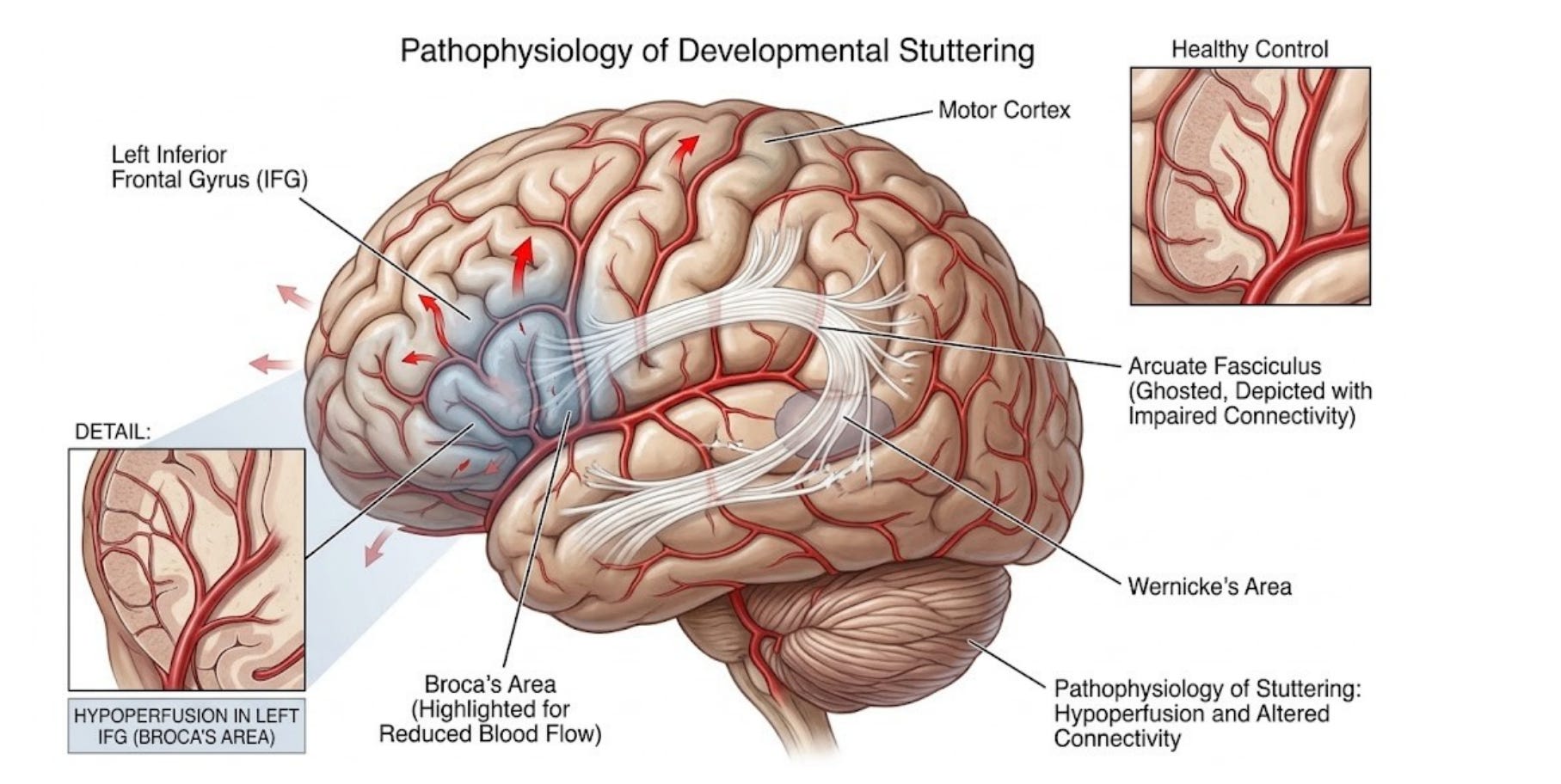
Brain imaging studies show reduced activity in left-hemisphere speech regions during speech, with greater reliance on the right hemisphere. Structural studies report reduced cortical thickness in the left inferior frontal gyrus (Broca’s area) in children who stutter, and weaker white matter connections, including the arcuate fasciculus, which links auditory and speech-planning regions. Current models identify the loop linking the cortex, basal ganglia and thalamus, which reads out stored speech motor programs, as a prime candidate for the core deficit. These studies are cross-sectional, so they cannot show whether the differences cause stuttering or result from years of stuttering. Anxiety and mood disorders are also more common in people who stutter, most likely as a consequence of living with the disorder.
Reduced blood flow at rest in speech regions is among the better-replicated findings. In a 2017 arterial spin labelling MRI study of 26 people who stutter and 36 controls, Desai and colleagues found lower blood flow in the inferior frontal gyrus on both sides in children and adults, and lower flow there correlated with more severe stuttering. A related theory holds that stuttering may partly reflect an impaired energy supply to neurons in a speech system with high energy demands. Whether reduced blood flow causes stuttering, results from it, or is unrelated to it has not been established.
The Published Science and Its Limits
On March 7, 2026, Ferreras and colleagues published a review and hypothesis paper on tPBM and developmental stuttering in the Journal of Clinical Medicine. Building on the deficits described above, they proposed that tPBM stimulates cytochrome c oxidase in the mitochondria, increasing ATP production and triggering nitric oxide-mediated vasodilation that raises regional cerebral blood flow. The authors state that whether tPBM benefits people who stutter has not yet been tested in clinical trials. Dose is also critical: light therapy follows a biphasic dose response, in which too low a dose has no effect and too high a dose can inhibit cellular function [3].
A single-person trial is a starting point, not a conclusion. My protocol had no sham device, and after the substitution was identified, I knew which wavelength I was using. No independent assessor scored my recordings. Expectation, practice, sleep and the normal day-to-day variation in fluency could each account for part of the change. My results identify what a controlled trial must include: sham controls, blinding, independent speech assessments and preregistered outcomes.
A Complement to Speech-Language Therapy
When I presented at the Canadian Stuttering Association conference in St. John’s in August 2026, most of the speech-language pathologists in attendance were unfamiliar with tPBM. I am a virologist, not a speech-language pathologist, and neither the webinar nor this post constitutes clinical advice. In my assessment, a person who stutters should work with a speech-language pathologist on breathing and speaking technique, and should consider light therapy, if at all, only as an adjunct to that work, never as a substitute for it.
A 2023 case report by Estrada-Rojas and Cedeño Ortiz [2], published in Photobiomodulation, Photomedicine, and Laser Surgery, describes a 38-year-old woman with aphasia following a left-hemisphere stroke. After five months of speech-language therapy alone, her speech rate was approximately 25 to 30 words per minute. After a further five months of tPBM combined with speech-language therapy, it exceeded 80 words per minute. The patient had aphasia rather than stuttering, and a single case cannot distinguish the effect of the light from the effect of continued therapy and recovery.
Next Steps and Acknowledgements
I am only one person, and my results cannot predict anyone else’s. It is my sincere wish that many others who stutter will find the same benefit I have, and that is why these findings must be tested properly. No clinical trial is yet under way, and none has ethics approval. If you are interested in discussing or setting up such a trial, I would be glad to work with you, and I welcome correspondence from people who stutter, speech-language pathologists and researchers at research@davidspeicher.com.
I thank Tom Kerber and the SunPower LED team for hosting the webinar, and Asad for sharing his own recovery alongside my presentation. In the interest of full disclosure, I serve as a retained scientific consultant to SunPower LED. The work continues, and I intend to see it carried through to a controlled trial.
References
Ferreras BI, Goyeneche M, Cassano P, Guenther FH, Tumanova V. Exploring Photobiomodulation as a Potential Novel Intervention for Developmental Stuttering: A Review and Hypothesis. J Clin Med. 2026;15(5):2041. PMID 41827457.
Estrada-Rojas K, Cedeño Ortiz NP. Increased Improvement in Speech-Language Skills After Transcranial Photobiomodulation Plus Speech-Language Therapy, Compared to Speech-Language Therapy Alone: Case Report with Aphasia. Photobiomodul Photomed Laser Surg. 2023;41(5):234–240. PMID 36999917.
Salehpour F, Mahmoudi J, Kamari F, Sadigh-Eteghad S, Rasta SH, Hamblin MR. Brain Photobiomodulation Therapy: a Narrative Review. Mol Neurobiol. 2018;55(8):6601–6636. PMID 29327206.
Support Independent Scientific Oversight
Scientific data and regulatory records belong in public view. All of our core genomic findings, peer-reviewed data and regulatory analyses will remain free and accessible to the public.
Independent molecular testing, and the work of documenting a single-person trial openly and reviewing the research behind it, require independent funding. If you value this work, please consider upgrading to a paid Substack subscription. Your support keeps this work free for the families, clinicians and lawmakers who use it.
Deploy the Blueprint & Hold the Line
Share the Evidence: Send the recording to a person who stutters, or to a speech-language pathologist who works with people who stutter. Ask which of the four requirements for a controlled trial they would prioritize.
Join the Conversation: In my experience, the effect persisted for approximately three days after a session and then declined. In a controlled trial of tPBM for stuttering, how long should participants be followed after treatment ends? Post your answer in the comments below.
Strategic Funding: To support our independent laboratory work directly, send an e-transfer to support@davidspeicher.com or contribute through my GiveSendGo campaign.
Advisory Engagements (Cyrus Scientific Inc.): As Chief Scientific Officer and Founder of Cyrus Scientific Inc., I take on retained advisory engagements in three areas: expert advisory for legal and policy matters, assay and R&D advisory, and regulatory and data review advisory. For advisory inquiries to Cyrus Scientific Inc., write to research@davidspeicher.com.
Monitor the Intelligence: Follow my updates on X (@DJSpeicher), and follow the Cyrus Scientific and Dr. David Speicher pages on LinkedIn.
.
My brother stuttered. It was not too bad where it interfered with his life, but I am sure it bothered him. I admire you for not letting it hold you back with your education! Especially since you were ADVISED (who needs advice like that?.?) to not go ahead with it! RESILIENCE! I wish I had more of it myself, and to be able to pass that character trait on to my children/grandchildren. How did you persevere?
Very interesting article, David. Thank you. I hope you continue to progress. I will call you this week, to hear for myself!