

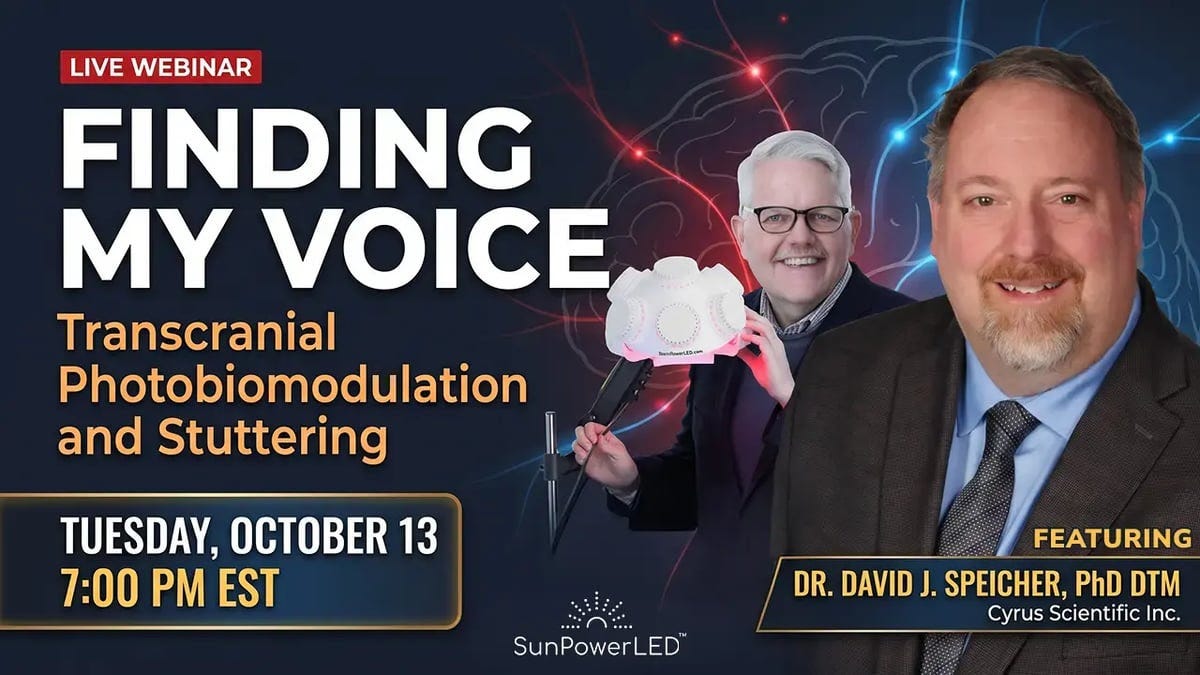
Tonight, Tuesday, October 13, 2026, at 7:00 PM Eastern Time, I will join Tom Kerber for a live webinar titled “Finding My Voice: Transcranial Photobiomodulation and Stuttering.” I am a person who has stuttered since I was a child. I have been picked on for it brutally over the years, and I have rarely spoken about it publicly. Tonight I will share my personal journey, including mindset, preparation, speaking pace and audience focus, and how my speaking has improved since I began working with transcranial photobiomodulation (i.e., red-light therapy on the head).
Transcranial photobiomodulation, or tPBM, uses red and near-infrared light delivered through the scalp. In the webinar, I will set out the science behind it: what the published research has examined, and where that research stops. The interest in this field is growing, and so is the risk of claims running ahead of the data. My aim is to show you where the line between the two sits.
The webinar covers more ground than my own story. We will look at what published brain-imaging studies report about blood flow and connectivity in the areas of the brain involved in speech, and at the proposed mechanisms by which 660 nm red light and 810 nm near-infrared light may act on cellular energy and cerebral blood flow. We will cover dosimetry, including wavelength, irradiance, fluence, exposure time and dose-response, and how commercial light-based devices differ. We will also review published research on tPBM in aphasia. Finally, we will set out what a controlled trial would require: sham controls, blinding, independent speech assessments and preregistered outcomes.
I will also walk through my own exploratory, single-person trial, including its protocol, speech-fluency observations and device comparisons. One person is a starting point, not a conclusion. A trial of one cannot separate the effect of the light from expectation, practice, or the ordinary variation in fluency from one day to the next. Tom and I will examine the findings, the limits of the evidence, and what future controlled research would need to investigate before anyone could draw a firm conclusion.
In August 2026, I presented on red-light therapy and stuttering to the Canadian Stuttering Association in St. John’s. Tonight’s webinar opens that discussion to a wider audience. It is for people who stutter and their families, for the speech-language pathologists and clinicians who work with them, and for researchers who may design the studies this field now needs. If any of those describes you, I would value your presence.
In the interest of full disclosure, I serve as a retained scientific consultant to SunPower LED, which is hosting this webinar. I will present the evidence as it stands, limits included, and I invite you to hold me to that standard. It is the same standard I apply in every other area of my work. Show the method, show the limits, and let the record speak.
I am grateful to Tom Kerber for the invitation and for his willingness to put the evidence ahead of the product. Registration is through Zoom using the button below. There will be time for your questions in a live Q&A. A recording will be made available after the event on SunPowerLED’s YouTube channel, and I will discuss it here with my readership.
There will be time for Q&A during the event.
Support Independent Scientific Oversight
Scientific data and regulatory records belong in public view. All of our core genomic findings, peer-reviewed data and regulatory analyses will remain free and accessible to the public.
Independent molecular testing, and the work of reviewing the research literature and documenting a trial openly, require independent funding. If you value this work, please consider upgrading to a paid Substack subscription. Your support keeps this research free for the families, clinicians and lawmakers who use it.
Deploy the Blueprint & Hold the Line
Share the Evidence: Send this post to someone who stutters, or to a speech-language pathologist who works with people who do. Ask them to join tonight and bring one question about the evidence.
Join the Conversation: Tonight’s discussion turns on what a controlled study of tPBM in stuttering would need to measure. Which single outcome would you want that study to track? Post your answer in the comments below.
Strategic Funding: To support our independent laboratory work directly, send an e-transfer to support@davidspeicher.com or contribute through my GiveSendGo campaign.
Advisory Engagements (Cyrus Scientific Inc.): As Chief Scientific Officer and Founder of Cyrus Scientific Inc., I take on retained advisory engagements in three areas: expert advisory for legal and policy matters, assay and R&D advisory, and regulatory and data review advisory. For advisory inquiries to Cyrus Scientific Inc., write to research@davidspeicher.com.
Monitor the Intelligence: Follow my updates on X (@DJSpeicher), and follow the Cyrus Scientific and Dr. David Speicher pages on LinkedIn.