

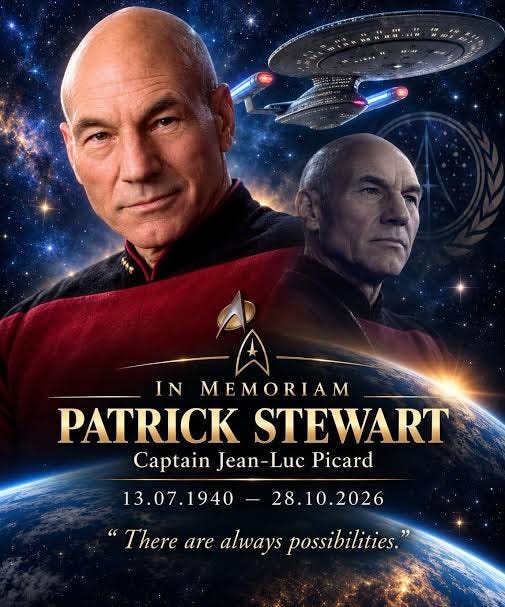
The Captain Who Never Just Followed Orders
As I sit here at my desk tonight after learning of the death of Sir Patrick Stewart, I find myself thinking less about an actor and more about the man he made real for so many of us...Captain Jean-Luc Picard. His family recently announced that he died on Wednesday, October 28, 2026, at the age of 86. For seven seasons of Star Trek: The Next Generation, four feature films and, later, Star Trek: Picard, he was Captain Jean-Luc Picard of the starship Enterprise. He was also, for a time, Locutus of Borg: the captain taken by force and turned against everything he stood for. The way Picard came back from that, wounded but unbroken, is part of why the character endured, and one of many lessons to reflect upon.
I have always been a Star Trek fan, and Picard was my favourite captain. He never just followed orders. He led with integrity, and he was not afraid to do the right thing, whatever the consequences to his career or to himself. He was a legendary leader and a defender of the weak and the marginalized. He stood for truth, held to strong morals, and brought discipline and dedication to every command he held.
Picard’s character showed most clearly when his orders and his conscience pulled in different directions, and he followed his conscience. He was a fictional man, yet the qualities he carried are real and as old as Scripture: the upright are guided by their integrity, not by the approval of the crowd. We live in a world more polarized and divided than at any time I can remember, and we need that kind of integrity now. Four of Picard’s lines have stayed with me for years, and I want to share them with you.
“Making Yourself More Than You Are”
In Star Trek: Nemesis, Picard faces Shinzon of Remus, a younger clone of himself raised in brutality and bent on revenge. Picard does not answer hatred with hatred. When Shinzon dismisses their shared potential as the past, Picard answers: “It can be the future. Buried deep within you, beneath all the years of pain and anger, there is something that has never been nurtured: the potential to make yourself a better man. And that is what it is to be human. To make yourself more than you are. Oh, yes — I know you. There was a time you looked at the stars and dreamed of what might be.” Picard saw in his enemy what his enemy could no longer see in himself.
A shortened form of those words sits at the top of my teaching portfolio, and it describes what I have tried to do with every student. I see my students as learners with enormous potential to grow and to shape the world around them, and my role is to facilitate and challenge that growth. One of my PhD students came from a dental background with no wet lab experience, and she needed to perform DNA extractions from 250 samples using a method I had developed. She was apprehensive at first, so I showed her the procedure and then had her walk me through it. Once she was proficient, I asked her to teach another student in our lab, and she did it remarkably well.
This matters to me personally. As a stutterer, I was told by many people that someone with a stutter could not teach effectively. They were wrong, and my PhD supervisor encouraged me to set that discouragement aside and teach. My stutter has since taught me empathy for students with learning disabilities, and it reminds me that a teacher’s first job is often to see potential before the student can. None of us is meant to stay as we are, shaped by the world around us. We are called to be transformed and renewed in heart and mind, and that is the work of a lifetime that none of us does alone.
“The First Duty … Is to the Truth”
In the episode “The First Duty”, a young cadet, Wesley Crusher, joins his squadron in concealing the truth about a training accident that cost a fellow cadet his life. Picard confronts him without softening a word: “The first duty of every Starfleet officer is to the truth, whether it’s scientific truth or historical truth or personal truth! It is the guiding principle on which Starfleet is based. And if you can’t find it within yourself to stand up and tell the truth about what happened, you don’t deserve to wear that uniform.” Wesley does tell the truth in the end, and it costs him dearly. Picard never pretended that honesty was free.
Over the past six years, few words have divided people more than the new terms “misinformation” and “disinformation”. As a scientist, my duty is the same one Picard named. I look at the data, I state the method and its limits, and I ask the difficult questions, even when the answers are unwelcome. The truth does not change because a crowd repeats something else, or because someone in authority denies it.
We must always stand on the unadulterated truth, whatever it turns out to be, even when it runs against the approved narrative, what we were taught, or how others want us to think. We must uphold the truth with courage, and do it with grace, telling the truth with love. Contempt has never changed anyone’s mind, and the truth, once it is known, still sets people free.
“How Many People Does It Take?”
In Star Trek: Insurrection, Admiral Dougherty orders the removal of the 600 Ba’ku villagers from their home world so that others can benefit from the planet. The plan has been approved, and the admiral argues that only a few people will be affected. Picard refuses to accept it: “How many people does it take, Admiral, before it becomes wrong? Hmm? A thousand? Fifty thousand? A million? How many people does it take, Admiral?” For Picard, the number of people did not decide whether it was right or wrong.
That question has followed me through my work on uncovering the contents of the COVID-19 modRNA vaccines. With Jessica Rose and Kevin McKernan, I published a peer-reviewed study in Autoimmunity in 2025 that quantified residual plasmid DNA and SV40 promoter-enhancer sequences in Pfizer/BioNTech and Moderna vials from Ontario, Canada. The regulatory agencies have never openly admitted to the truth of the plasmid DNA or SV40 sequences. Nevertheless, the vaccine-injured and their families deserve a full and honest accounting of what was in those vials, and how it may have affected people’s health.
So I ask Picard’s question again. How many people need to be injured before we admit that harm has been done, and act on it? How many people need to be killed before it’s considered wrong. A good shepherd leaves the ninety-nine that are safe and goes out to look for the one that is lost. No life is expendable. Every vaccine-injured person I have met is a valuable person that deserves to be listened to and helped. They are not a statistic.
Time: Predator or Companion?
In Star Trek Generations, Dr Tolian Soran is consumed by his own mortality. He tells Picard, “They say ‘time is the fire in which we burn.’ Right now, Captain, my time is running out. We leave so many things unfinished in our lives.” To Soran, time is “like a predator; it’s stalking you. Oh, you can try and outrun it with doctors, medicines, new technologies. But in the end, time is going to hunt you down... and make the kill.” He is willing to sacrifice others to escape back into the Nexus, of which he says, “Time has no meaning there. The predator has no teeth.” Soran saw time as an enemy, so he spent his life running from it, and others paid the price.
Picard had every reason to share that view. Earlier in the film he learns of a loss in his own family, and by the end his ship lies wrecked on a distant planet. Standing in the ruins with Commander Riker, he chooses differently: “Someone once told me that time was a predator that stalked us all our lives, but I rather believe that time is a companion who goes with us on the journey, and reminds us to cherish every moment — because they’ll never come again.” Both men knew their time was limited, but only Picard chose to be grateful for it.
Our days are numbered, and we must be wise and learn to count them. Knowing that death is inevitable should not frighten us. It should wake us up. We must value the times that we have to make memories with the people we love. Put the phone down at dinner, call the parent you have been meaning to call, and be fully present with your family, because those moments will never come again.
Living Upright in a Divided World
Picard’s legacy is not a list of victories. It is a pattern of choices: to see potential in an enemy, to tell the truth when it costs something, to refuse a wrong no matter how small the number, and to treat time as a gift. Any of us can make those same choices today, without a uniform or a starship. God asks us to act justly, to love mercy and to walk humbly with Him, and that is easier to say than to live.
As I close my laptop tonight, I am grateful for a captain who taught this lifelong Star Trek fan that good leadership comes from character. Thank you, Sir Patrick, for giving him to us. The Enterprise has lost its captain, but the course he set is still there for anyone who will follow it. Make it so.
Vale, Captain Jean-Luc Picard
Support Independent Scientific Oversight
Scientific data and regulatory records belong in public view, and our core genomic findings, peer-reviewed data and regulatory analyses will remain free to the public. Independent molecular testing requires independent funding. If you value this work, please consider a paid Substack subscription, which keeps this science free for the families, clinicians and lawmakers who use it.
Deploy the Blueprint & Hold the Line
Share the Evidence: Send this post to a fellow Star Trek fan, a student or a young person starting out. Ask them which of Picard’s four lines they would choose to live by.
Join the Conversation: Of Picard’s four lines here (Shinzon, “The First Duty”, the Ba’ku, and time as a companion), which has shaped you most? Let me know if you have another favourite quote. Post your choice in the comments below.
Strategic Funding: To support our independent laboratory work directly, send an e-transfer to support@davidspeicher.com or contribute through my GiveSendGo campaign.
Advisory Engagements (Cyrus Scientific Inc.): As Chief Scientific Officer and Founder of Cyrus Scientific Inc., I take on retained advisory engagements in three areas: expert advisory for legal and policy matters, assay and R&D advisory, and regulatory and data review advisory. For advisory inquiries to Cyrus Scientific Inc., write to research@davidspeicher.com.
Monitor the Intelligence: Follow my updates on X (@DJSpeicher), and follow the Cyrus Scientific and Dr. David Speicher pages on LinkedIn.